# Envin - type-safe environment variable validation tool with live previews
> Say goodbye to runtime environment variable errors with Envin. Get type-safe validation, live previews, and an interactive CLI that works across frameworks.
Published: 2025-06-21 · Tags: web, mobile, extension, development, open-source
Environment variables are the silent killers of JavaScript applications. One missing `DATABASE_URL`, an incorrect `API_ENDPOINT`, or a mistyped boolean value can bring your entire production deployment to its knees. We've all been there - spending hours debugging why your app works locally but fails in production, only to discover a single environment variable wasn't properly configured.
That's why we're excited to introduce **[Envin](https://envin.turbostarter.dev)** - our new open-source library that brings type-safe environment variable validation to any JavaScript framework. Whether you're building with [Next.js](https://www.turbostarter.dev/docs/web), [React Native](https://www.turbostarter.dev/docs/mobile), [browser extensions](https://www.turbostarter.dev/docs/extension), or any other framework, [Envin](https://envin.turbostarter.dev) ensures your environment variables are validated, typed, and accessible with full TypeScript support.
## What is Envin?
[Envin](https://envin.turbostarter.dev) is a framework-agnostic, type-safe tool designed to validate and preview your environment variables using your favorite schema validator. Built with developers in mind, it provides:
* **Type-safe validation** - Define your schema once and get full TypeScript support
* **Framework-agnostic design** - Works with Next.js, Vite, Astro, React Native, and any JavaScript framework
* **Client/server separation** - Strict protection of server-side variables from client access
* **Interactive CLI** - Real-time previews and validation during development
* **Extensible presets** - Pre-configured setups for popular platforms
* **[Standard Schema](https://envin.turbostarter.dev/docs/validators) support** - Works with [Zod](https://zod.dev/), [Yup](https://github.com/jquense/yup), [Joi](https://github.com/sideway/joi), and other popular validators
Being open-source means complete transparency and community-driven development - you can inspect the code, contribute features, and ensure your project's foundation is secure from day one.
## Why environment variable validation matters for startups?
In the fast-paced startup environment, configuration errors can be costly. Consider these common scenarios:
* **Production deployments** fail because a required environment variable is missing
* **API integrations** break due to incorrect endpoint URLs
* **Security vulnerabilities** emerge from exposed sensitive variables
* **Team onboarding** takes longer because environment setup is complex
* **Cross-environment bugs** waste precious development time
[Envin](https://envin.turbostarter.dev) addresses these challenges by providing a robust, type-safe foundation for environment variable management that scales with your startup's growth.
> Environment variables should be boring. When they're properly validated and typed, you can focus on building features instead of debugging configuration issues.
## Getting started with Envin
Getting started with [Envin](https://envin.turbostarter.dev) is incredibly straightforward, making it accessible for projects of any size.
### Installation
Install the core package alongside your preferred schema validator:
```bash
# Using npm
npm install envin zod
# Using yarn
yarn add envin zod
# Using pnpm
pnpm add envin zod
```
💡 Pro tip: [Envin](https://envin.turbostarter.dev) supports any [Standard
Schema](https://envin.turbostarter.dev/docs/validators) validator, so you can
use [Zod](https://zod.dev/), [Yup](https://github.com/jquense/yup),
[Joi](https://github.com/sideway/joi), or any other validator you prefer!
### Basic configuration
Create an `env.config.ts` file in your project root:
```typescript
import { defineEnv } from "envin";
import * as z from "zod";
const env = defineEnv({
shared: {
NODE_ENV: z.enum(["development", "production"]),
},
server: {
DATABASE_URL: z.url(),
JWT_SECRET: z.string().min(32),
},
client: {
NEXT_PUBLIC_API_URL: z.url(),
NEXT_PUBLIC_APP_URL: z.url(),
},
clientPrefix: "NEXT_PUBLIC_",
});
export default env;
```
### Using validated environment variables
Once configured, access your environment variables with full TypeScript support:
```typescript
import env from "./env.config";
// ✅ Fully typed and validated
const databaseUrl = env.DATABASE_URL; // string
const apiUrl = env.NEXT_PUBLIC_API_URL; // string
const nodeEnv = env.NODE_ENV; // "development" | "production"
// ❌ TypeScript error - server variable on client
const secret = env.JWT_SECRET; // Error: Cannot access server variable on client
```
## Key features that set Envin apart
### Framework-agnostic design
Unlike other environment validation tools that are tied to specific frameworks, [Envin](https://envin.turbostarter.dev) works seamlessly across the JavaScript ecosystem:
| Framework | Support | Client Prefix | Built-in Presets |
| ------------- | ------- | -------------- | ---------------- |
| Next.js | ✅ | `NEXT_PUBLIC_` | ✅ |
| Vite | ✅ | `VITE_` | ✅ |
| Astro | ✅ | `PUBLIC_` | ✅ |
| React Native | ✅ | Custom | ✅ |
| Node.js | ✅ | N/A | ✅ |
| Any Framework | ✅ | Configurable | ✅ |
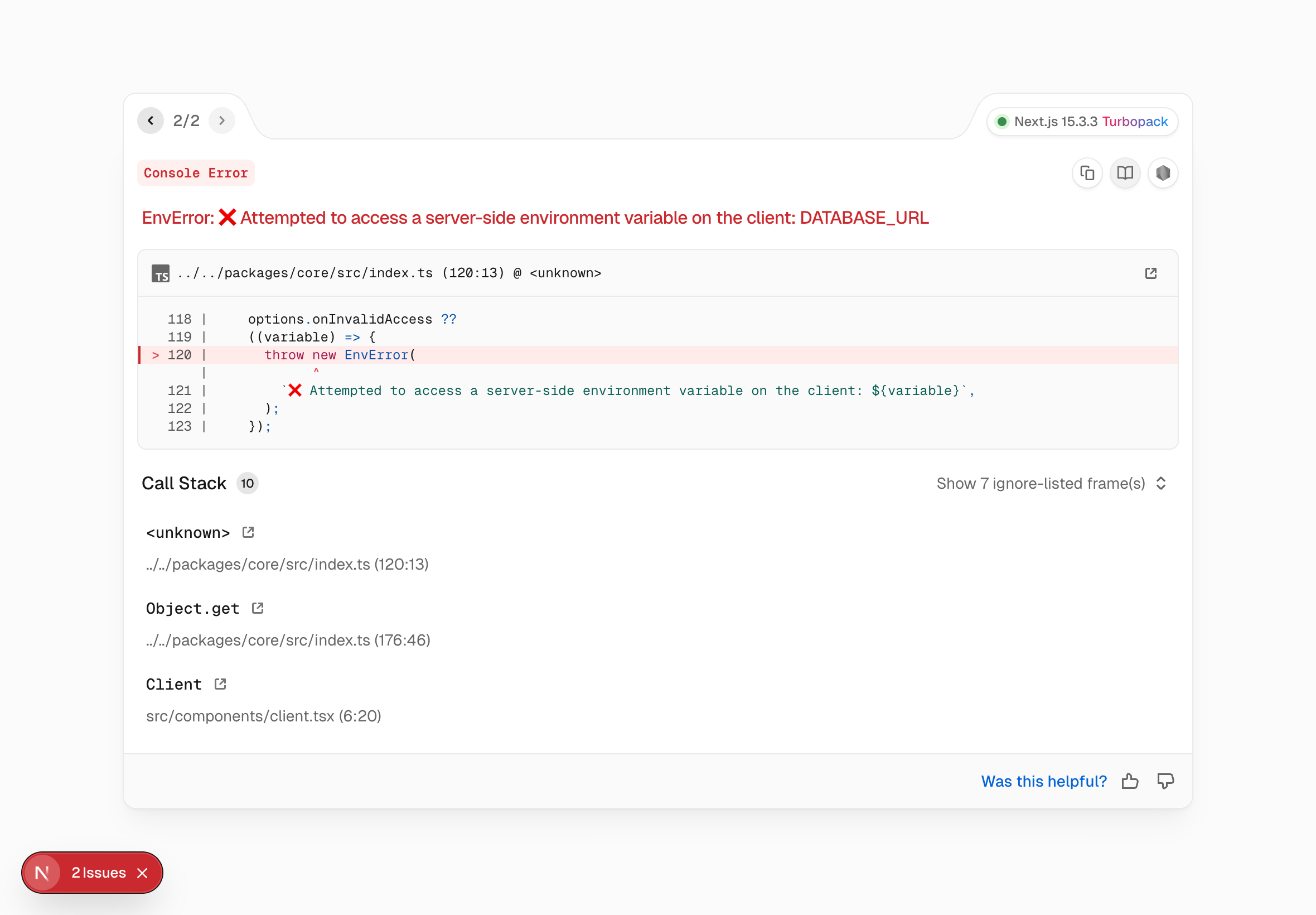
### Strict client/server separation
[Envin](https://envin.turbostarter.dev) provides built-in protection against accidentally exposing server-side environment variables to the client:
```typescript
// Client-side component
"use client";
import env from "../../env.config";
export const ClientComponent = () => {
// ❌ This will throw a clear error message
return {env.DATABASE_URL}
;
// ✅ This works perfectly
return {env.NEXT_PUBLIC_API_URL}
;
};
```
This protection helps prevent security vulnerabilities and makes it impossible to accidentally expose sensitive information like database URLs or API keys to the client.
### Interactive CLI with live previews
The [Envin CLI](https://envin.turbostarter.dev/docs/live-preview) provides an interactive development experience with real-time validation:
```bash
# Preview your environment variables
npx @envin/cli@latest dev
```
The CLI generates a beautiful web interface that:
* Displays all your environment variables with their current values
* Shows validation status for each variable
* Highlights missing or invalid configurations
* Provides helpful error messages and suggestions
* Updates in real-time as you modify your `.env` files
This is particularly valuable for:
* **Debugging configuration issues** during development
* **Onboarding new team members** with clear visual feedback
* **Validating production environments** before deployment
## Integrating Envin with modern development workflows
### Monorepo compatibility
[Envin](https://envin.turbostarter.dev) works beautifully in monorepo environments, especially when combined with [Turborepo](https://www.turbostarter.dev/blog/turborepo-the-ultimate-guide-to-modern-javascript-monorepo-management):
```typescript
// packages/env/env.config.ts
export const createEnv = (clientPrefix: string) =>
defineEnv({
shared: {
NODE_ENV: z.enum(["development", "production"]),
},
server: {
DATABASE_URL: z.url(),
},
client: {
[`${clientPrefix}API_URL`]: z.url(),
},
clientPrefix,
});
// apps/web/env.config.ts
import { createEnv } from "@acme/env";
export default createEnv("NEXT_PUBLIC_");
// apps/mobile/env.config.ts
import { createEnv } from "@acme/env";
export default createEnv("EXPO_PUBLIC_");
```
### TypeScript integration
[Envin](https://envin.turbostarter.dev) leverages TypeScript's power to provide compile-time safety:
```typescript
// Type inference works automatically
const config = {
apiUrl: env.NEXT_PUBLIC_API_URL, // Inferred as string
retries: parseInt(env.RETRY_COUNT), // You handle type conversion
features: {
auth: env.NODE_ENV === "production", // Type-safe comparisons
},
};
```
For additional TypeScript improvements, explore our guide on [making your TypeScript smarter with one line of code](https://www.turbostarter.dev/blog/make-your-typescript-smarter-with-one-line-of-code).
## Advanced Envin techniques
### Custom validation logic
[Envin](https://envin.turbostarter.dev) supports complex validation scenarios:
```typescript
const env = defineEnv({
server: {
DATABASE_URL: z
.string()
.url()
.refine(
(url) => url.startsWith("postgresql://"),
"Database URL must be a PostgreSQL connection string",
),
REDIS_URL: z.url().optional(),
PORT: z.coerce.number().min(1000).max(65535).default(3000),
},
client: {
NEXT_PUBLIC_APP_URL: z
.string()
.url()
.refine(
(url) => !url.endsWith("/"),
"App URL should not end with a trailing slash",
),
},
clientPrefix: "NEXT_PUBLIC_",
});
```
### Environment-specific configurations
Handle different environments elegantly:
```typescript
const env = defineEnv({
shared: {
NODE_ENV: z.enum(["development", "staging", "production"]),
},
server: {
DATABASE_URL: z.url(),
LOG_LEVEL: z
.enum(["debug", "info", "warn", "error"])
.default(process.env.NODE_ENV === "development" ? "debug" : "info"),
},
clientPrefix: "NEXT_PUBLIC_",
});
```
### Integration with existing tools
[Envin](https://envin.turbostarter.dev) plays well with other development tools:
```typescript
// Works with dotenv
import "dotenv/config";
import env from "./env.config";
// Integrates with config libraries
export const config = {
database: {
url: env.DATABASE_URL,
ssl: env.NODE_ENV === "production",
},
api: {
baseUrl: env.NEXT_PUBLIC_API_URL,
timeout: parseInt(env.API_TIMEOUT || "5000"),
},
};
```
## Envin vs. existing solutions
| Feature | [Envin](https://envin.turbostarter.dev) | t3-env | dotenv-safe | envsafe |
| ------------------------ | --------------------------------------------------------------------- | --------------- | ----------- | -------- |
| Framework Support | Any | Next.js focused | Any | Any |
| TypeScript Support | ✅ Full | ✅ Full | ❌ Limited | ✅ Full |
| Client/Server Separation | ✅ Built-in | ✅ Built-in | ❌ Manual | ❌ Manual |
| Interactive CLI | ✅ Live Preview | ❌ None | ❌ None | ❌ None |
| Schema Validator | Any [Standard Schema](https://envin.turbostarter.dev/docs/validators) | Zod only | Custom | Custom |
| Runtime Validation | ✅ | ✅ | ✅ | ✅ |
| Development Experience | ✅ Excellent | ✅ Good | ❌ Basic | ❌ Basic |
## Real-world use cases
### E-commerce platforms
For e-commerce applications built with [TurboStarter](https://www.turbostarter.dev), [Envin](https://envin.turbostarter.dev) ensures:
```typescript
const env = defineEnv({
server: {
STRIPE_SECRET_KEY: z.string().startsWith("sk_"),
DATABASE_URL: z.url(),
WEBHOOK_SECRET: z.string().min(20),
},
client: {
NEXT_PUBLIC_STRIPE_PUBLISHABLE_KEY: z.string().startsWith("pk_"),
NEXT_PUBLIC_APP_URL: z.url(),
},
clientPrefix: "NEXT_PUBLIC_",
});
```
### SaaS applications
For SaaS products with complex integrations:
```typescript
const env = defineEnv({
server: {
DATABASE_URL: z.url(),
REDIS_URL: z.url(),
EMAIL_SERVICE_API_KEY: z.string().min(10),
ANALYTICS_API_KEY: z.string().min(10),
PAYMENT_WEBHOOK_SECRET: z.string().min(20),
},
client: {
NEXT_PUBLIC_APP_URL: z.url(),
NEXT_PUBLIC_ANALYTICS_ID: z.string().min(5),
},
clientPrefix: "NEXT_PUBLIC_",
});
```
### Mobile applications
For React Native apps using [Expo](https://www.turbostarter.dev/docs/mobile):
```typescript
const env = defineEnv({
shared: {
NODE_ENV: z.enum(["development", "production"]),
},
client: {
EXPO_PUBLIC_API_URL: z.url(),
EXPO_PUBLIC_APP_SCHEME: z.string().min(3),
},
clientPrefix: "EXPO_PUBLIC_",
});
```
## The future of Envin
We're committed to continuously improving [Envin](https://envin.turbostarter.dev) with exciting features on our roadmap:
| Feature | Description | Status |
| --------------------- | ------------------------------------- | -------------- |
| Visual Schema Builder | GUI for creating environment schemas | In Development |
| Team Collaboration | Shared environment templates | Planned |
| Cloud Validation | Remote environment validation service | Planned |
| IDE Extensions | VS Code and other editor integrations | Planned |
| Auto-migration | Automatic schema updates | Researching |
## Getting involved with the community
[Envin](https://envin.turbostarter.dev) is open-source and community-driven. Here's how you can get involved:
### Contributing
We welcome contributions of all kinds:
1. 🐛 **Report bugs** on [GitHub Issues](https://github.com/turbostarter/envin/issues)
2. 💡 **Suggest features** through [GitHub Discussions](https://github.com/turbostarter/envin/discussions)
3. 📝 **Improve documentation** with pull requests
4. 🔧 **Submit code** following our contribution guidelines
5. ⭐ **Star the repository** to show your support
### Community support
Join our vibrant developer community:
🌟 Join our [Discord community](https://www.turbostarter.dev/discord) to connect with other developers
using [Envin](https://envin.turbostarter.dev) and get help with your
environment variable challenges!
### Integration with TurboStarter
While [Envin](https://envin.turbostarter.dev) is completely free and open-source, it integrates seamlessly with [TurboStarter kits](https://www.turbostarter.dev/pricing) for an even better development experience. TurboStarter customers get:
* Pre-configured [Envin](https://envin.turbostarter.dev) setups for web, mobile, and extension projects
* Advanced environment templates for common use cases
* Priority support for [Envin](https://envin.turbostarter.dev)-related questions
* Early access to new [Envin](https://envin.turbostarter.dev) features and integrations
## Start building with confidence today
Environment variable management doesn't have to be a source of stress and bugs. With [Envin's](https://envin.turbostarter.dev) type-safe validation, framework-agnostic design, and interactive development tools, you can ensure your applications are properly configured from development to production.
Whether you're building a simple side project or scaling a complex enterprise application, [Envin](https://envin.turbostarter.dev) provides the foundation you need to manage environment variables with confidence.
```bash
# Get started in seconds
npm install envin zod
# Try the interactive CLI
npx @envin/cli dev
```
### Ready to eliminate environment variable bugs forever?
Start using [Envin](https://envin.turbostarter.dev) today and join the developers who are building more reliable applications with type-safe environment variable validation.
For comprehensive documentation and advanced usage examples, visit the [Envin documentation](https://envin.turbostarter.dev/docs).
For those looking to accelerate their development even further, check out our [TurboStarter kits](https://www.turbostarter.dev/pricing) which come with [Envin](https://envin.turbostarter.dev) pre-configured alongside authentication, database connections, and deployment setups.
If you're working with modern development workflows, explore our guides on [Turborepo CLI techniques](https://www.turbostarter.dev/blog/10-advanced-turbo-cli-techniques-to-boost-your-development-workflow) and [Cursor AI best practices](https://www.turbostarter.dev/blog/best-practices-for-cursor-ai-to-build-your-startup-10x-faster) to maximize your productivity.
***
**Open source and free forever.** Support the project by [starring our GitHub repository](https://github.com/turbostarter/envin) and sharing it with your fellow developers. Together, let's make environment variable bugs a thing of the past! 🚀
Have you tried [Envin](https://envin.turbostarter.dev) in your projects? We'd love to hear your feedback and use cases! Share your experience on [GitHub Discussions](https://github.com/turbostarter/envin/discussions) or join our [Discord community](https://www.turbostarter.dev/discord) to connect with other developers.
More posts: [blog](https://www.turbostarter.dev/blog.md)