Polar Payments Review (2026): Fees, MoR, and Tradeoffs
Honest Polar payments review for SaaS: 24 Nov 2026 fees, what the merchant of record covers, payouts, and when to choose Stripe, Creem, or Lemon Squeezy.
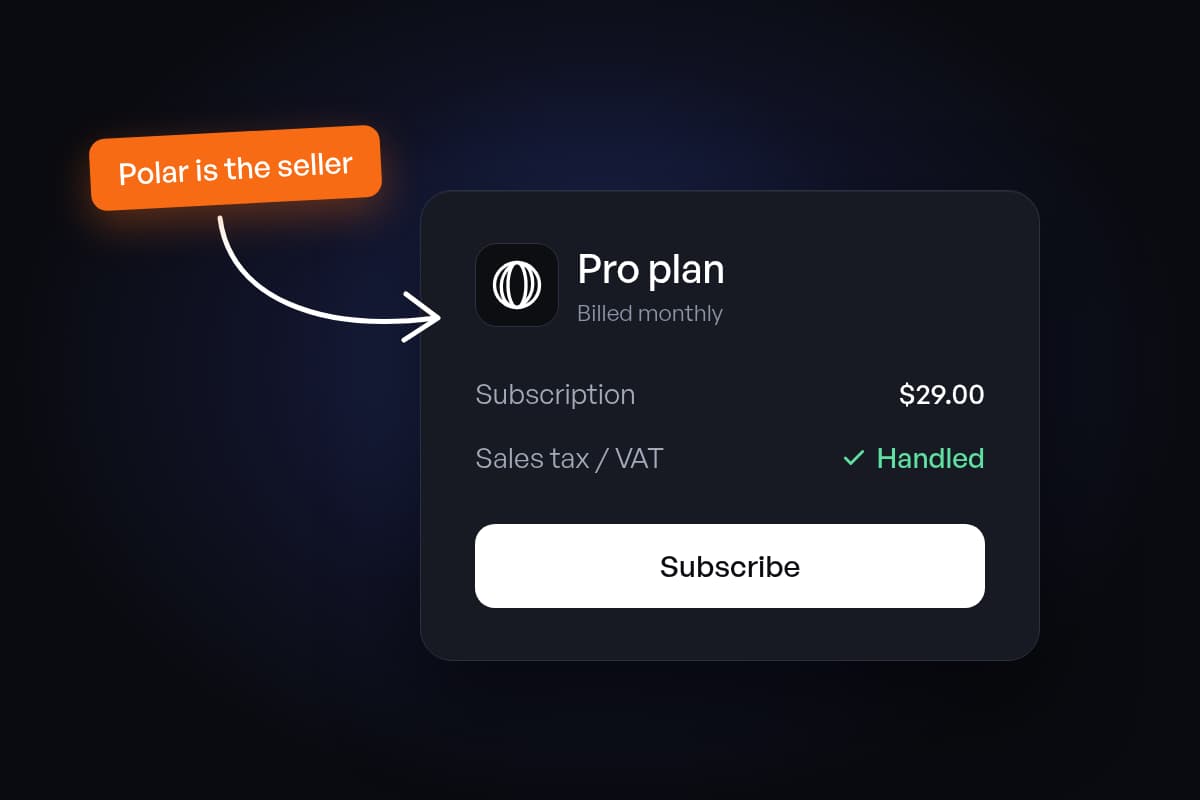
Polar payments are the charges Polar (polar.sh) takes when it sells your software as the merchant of record. Polar is an open-source billing platform for developers: it resells the product, collects sales tax and VAT, and pays you through a Stripe Connect Express account. This review is the decision in front of a founder who has to pick a seller. Fees, payout rules, and product limits below were read from Polar's docs and homepage, Lemon Squeezy's fee docs, Creem's pricing page, and Stripe's pricing page on 24 November 2026.
If you want the four-way fee table, start with Stripe vs Lemon Squeezy vs Polar vs Creem. The seller-versus-processor model is in the merchant of record guide.
Short answer
Use Polar if you sell software or other digital goods, you want one company to own sales tax, VAT, invoices, and chargebacks, and you can receive payouts in one of the 118 countries on Polar's Stripe Connect Express list. The free Starter plan is 5% + 50¢, plus 1.5% on non-US cards. Paid plans drop that rate if your volume clears Polar's published breakeven.
Skip Polar if you need the lowest card rate and can file indirect tax yourself (use Stripe), if the lowest published merchant-of-record rate matters more than benefits and an open-source API (look at Creem), if you need PayPal, or if your country is not on the payout list. Lemon Squeezy is not a new-store alternative: it stops processing on 31 March 2027.
Definition: Polar is a merchant of record and billing platform. On a successful checkout, Polar is the legal seller. You get a payout of the balance minus Polar's fee and the Stripe payout fees Polar passes through. You still owe income tax where you live.
What Polar is
Polar's own docs call it an open-source merchant of record. The homepage says Polar acts as the reseller of your product in over 100 markets, and that payments, sales tax, fraud, refunds, and chargebacks sit with Polar. The same page describes a Startup Program that gives early-stage AI startups the Scale plan free for 12 months. That is an application, not a rate you should put in a spreadsheet until you are accepted.
Under the hood, Polar's merchant-of-record introduction still says Polar is built on Stripe, with more payment service providers planned. Payouts are a separate Stripe product: Stripe Connect Express. Customers pay Polar. Your Connect account only receives transfers. That is why founders in countries where Stripe Payments is invite-only, including India, can still get paid, as long as Connect Express supports their country and business type.
The source is public at github.com/polarsource/polar. Open source does not mean you self-host the merchant of record. Tax registrations and the card relationship stay with Polar. You get a readable API and a product you can leave.
Polar payments fees
Everything in this section is from Polar's fees page, read on 24 November 2026. There is no monthly fee on Starter. Paid plans replace part of the per-transaction premium with a fixed fee and a lower rate. You can switch plans, and the rate changes immediately.
| Plan | Monthly fee | Per transaction | Polar's breakeven vs Starter |
|---|---|---|---|
| Starter | Free | 5% + 50¢ | - |
| Pro | $20 | 3.8% + 40¢ | about $1,379/mo in sales |
| Growth | $100 | 3.6% + 35¢ | about $5,634/mo in sales |
| Scale | $400 | 3.4% + 30¢ | about $19,048/mo in sales |
Those breakeven figures are Polar's, not a number we fitted. Below the line, stay on the cheaper plan. Above it, the paid plan saves money and also moves you up the support queue. Scale adds Slack and single sign-on. Paid plans also gate a few preview features: a shared Slack channel benefit, a reset proration behavior, and off-session charges against a saved card.
Extra fees, refunds, and disputes
These sit on top of the plan rate:
- +1.5% for international cards (cards issued outside the US), on every plan.
- +0.5% on subscription payments, Early Member only. Starter, Pro, Growth, and Scale do not add a subscription percentage.
- Disputes: $15 each, deducted from your balance, whether you win or lose. Polar says the card networks charge this and Polar does not refund it.
- Refunds: full or partial. The original transaction fee is not returned. Polar also reserves the right to refund a purchase itself for up to 60 days when that avoids a dispute.
Early Member is the old rate, and only for organizations created before 27 May 2026: 4% + 40¢, plus 0.5% on subscriptions, with no monthly fee. It lasts as long as you stay on it. The moment you move to a paid plan, Early Member is gone for that organization. Downgrading later lands you on Starter at 5% + 50¢, not the old rate. A new organization created on or after 27 May 2026 starts on Starter even if the founder already had an older org.
Polar's own worked example is a $30 product bought from Sweden with 25% VAT on an international card. The taxable total is $37.50. On Starter the fee is $2.94 ($2.38 transaction fee plus $0.56 international). Pro is $2.39, Growth $2.26, Scale $2.14. The useful lesson is not the Sweden VAT rate. Polar calculates the percentage on the tax-inclusive total, so a VAT-inclusive checkout costs more than the same list price with tax left off.
What a $29 plan costs
One $29 charge, list price, tax not added on top, so the rows match. Non-US means the +1.5% international card fee where that vendor prints one. Amounts are rounded to the cent (half up). Stripe here is card processing only. Billing and Tax are extra, and this post does not restate them. That math lives in Polar vs Stripe.
| Setup (24 Nov 2026) | US card | Non-US card |
|---|---|---|
| Polar Starter (5% + 50¢, +1.5% non-US) | $1.95 | $2.39 |
| Polar Pro (3.8% + 40¢, +1.5% non-US, plus $20/mo) | $1.50 | $1.94 |
| Polar Early Member subscription (4.5% + 40¢, +1.5%) | $1.71 | $2.14 |
| Lemon Squeezy subscription (5% + 0.5% + 50¢, +1.5%) | $2.10 | $2.53 |
| Creem (3.9% + 40¢, pricing page says no intl card fee) | $1.53 | $1.53 |
| Stripe US cards (2.9% + 30¢, +1.5% international cards) | $1.14 | $1.58 |
Sources: Polar fees, Lemon Squeezy fees, Creem pricing, Stripe pricing.
On 100 of those US charges ($2,900), the rounded per-charge fees add up to about $195 on Polar Starter, $170 on Polar Pro once you include the $20 plan, $171 on Early Member, $210 on Lemon Squeezy, $153 on Creem, and $114 on Stripe card processing alone. Stripe looks cheapest because you are still the seller. Creem looks cheapest among the merchant-of-record rows on this page. Polar Pro beats Starter only after Polar's own ~$1,379/mo sales line, which a $2,900 month already clears.
Payout costs
Polar does not add a markup on payouts. It passes through Stripe's fees, from the same fees page and the payouts doc:
- $2 in each month you have at least one active payout
- 0.25% + $0.25 per payout
- Cross-border currency conversion: 0.25% in the EU, up to 1% in other countries
Withdrawals are manual, so you choose when to pay that fixed cost. Polar will eventually pay out a balance you leave sitting for several months. The minimum for USD is $10. Some currencies and a few countries (Bahamas and El Salvador at $30, Panama at $50) are higher. The full table is on the payouts page. Do not assume $10 if you are not paid in USD.
Transactions for organizations created on or after 12 May 2026 wait 7 days before the funds can be withdrawn. Older organizations still get instant availability. Polar can lengthen that window to match your refund policy, or for risk.
What the merchant of record covers
A merchant of record is the company on the receipt. Polar's introduction splits the job in two, and the second half is the one people skip.
Capturing tax means charging the right VAT, GST, or US sales tax and holding it. Polar says it uses Stripe Tax for that. A Swedish consumer on a $10 plan pays $12.50 at 25% VAT. A Swedish business with a VAT number can be reverse-charged and pay $10.
Remitting tax means registering, filing, and paying the authorities. Stripe Tax does not do that for you. Polar does, because Polar is the reseller. Polar says it is registered in jurisdictions around the world and works with accounting firms to watch thresholds and file. The homepage lists payments, sales tax, fraud, refunds, and chargebacks as Polar's responsibility.
The customer portal is where the paperwork shows up for the buyer: invoices they can download and edit (company name, VAT number, billing address), and a receipt per paid order.
What it does not cover
Polar says this in the same introduction, in plain language: a merchant of record handles indirect tax. You still owe income or corporate tax where you live.
Three other limits are easy to miss:
- More buyers may see tax. If you sell direct, only your volume counts toward a country's threshold. Polar's volume counts, so tax can apply sooner than it would on your own Stripe account. Polar also notes you cannot use inbound VAT as your own deduction.
- You give up processor-level control. Polar's docs describe the tradeoff directly: a higher-level API and tax handling, in exchange for higher fees and less flexibility on advanced pricing models.
- The product has to be something Polar will resell. Software, SaaS, templates, courses, and similar digital goods are in. Physical goods, human services, and marketplaces are not. Details are below.
For the longer version of "do I even want a merchant of record", use the merchant of record guide.
Products, subscriptions, usage, and benefits
Products are the unit. A one-time purchase and a subscription are both products. The billing cycle is locked at creation: once, or daily, weekly, monthly, or yearly, with an interval count (every 3 months, every 2 weeks). Pricing type is also locked. Fixed prices can change later, and existing subscribers stay on the price they bought. To change the cycle, you create a new product.
Polar does not do "variants" the way Lemon Squeezy does. A monthly plan and a yearly plan are two products, shown together at checkout. That is the same model TurboStarter's Polar setup warns you about: the product ID in your config is the price, not a variant on a parent product.
Pricing models on that page:
- Fixed price, pay what you want (minimum and default), or free
- Metered prices, which can sit on top of a fixed base, including more than one meter on the same product
- Seat-based prices, with the buyer assigning seats
Usage-based pricing has three shapes: unit (a flat amount per unit), volume (one rate for the whole period once you cross a tier), and graduated (each tier keeps its own rate). You enter the price per single unit. The meter decides whether customers see that as "$0.10 each" or "$20 / 1M tokens". By default, usage is invoiced with the subscription renewal. A separate meter cycle can bill usage on its own cadence, for example monthly overage on a yearly plan, as long as the cycle divides the billing interval evenly. Customers can see estimated meter charges in the portal.
Failed meter-cycle payments retry after 2, 7, 14, and 21 days, which Polar says is the same schedule as failed subscription payments. A failed usage invoice does not revoke the subscription. If the renewal itself goes past due, the meter cycle pauses and the accrued usage is invoiced when the subscription recovers.
Benefits are what the customer actually receives, granted and revoked with the purchase. The product docs list license keys, Discord roles, GitHub repository access, file downloads, feature flags, and custom benefits. Credits are a separate benefit for metered products. The shared Slack channel is one of the paid-plan previews, not a Starter feature.
License keys are the one worth reading before you promise them to desktop-app customers. You can set a prefix, an activation limit (devices or other conditions), a usage quota, and an expiry on one-time purchases. Subscription keys ignore that expiry: they stay valid while the subscription is active and are revoked when it ends. Validate status, not expires_at, for those. Customers can copy, inspect, and rotate a key from the portal. Validation goes through Polar's customer-portal API, so you do not stand up your own license server on day one. A manual edit to expires_at gets overwritten the next time Polar reapplies the benefit.
Checkout and the customer portal
Checkout can be a persistent checkout link, a Checkout Session you create from the API, or an embedded checkout. Payment methods are chosen for you from the buyer's location, currency, device, and whether the purchase is one-time or recurring. You do not toggle them per organization.
From the payment methods page on 24 November 2026: cards worldwide, Apple Pay, Google Pay, Stripe Link, plus Amazon Pay, Cash App Pay, and WeChat Pay in the cases Polar lists. Local methods include Bancontact, EPS, iDEAL / Wero, UPI, and the Korean wallets. PayPal is not supported, and Polar says it has no timeline. Several local methods are one-time only. UPI and Kakao Pay / Naver Pay also work for subscriptions.
Two checkout details bite production apps:
- Currency follows the IP that creates the session. Products can be priced in 130+ currencies. If your server creates the session, Polar sees the server's country unless you pass the customer's IP. The docs call the field
customer_ip_address. - Tax-inclusive versus exclusive defaults to the buyer's country: inclusive in most of the world, exclusive in the US, Canada, and India. You can override the organization default.
The hosted customer portal cannot be turned off. Polar keeps it so buyers can always get invoices, cancel the same way they subscribed (they cite California's automatic-renewal rule), and update a card without you touching PAN data. You can turn off extras such as plan changes. The hosted page is not brandable. A custom portal uses the Customer Portal API, including an embedded payment-method flow so card details still never hit your server. Sign-in is a one-time code to the purchase email, or a pre-authenticated link you generate. Polar already puts a portal link in order, renewal, and failed-payment emails.
The Polar API, SDK, and webhooks
Polar's docs index lists API versions 2026-04, 2026-10, and 2027-01. The practical surface for a SaaS is checkouts, subscriptions, orders, customers, meters, license keys, and webhooks, plus a CLI that forwards webhooks to your machine and can fire sample events.
The Better Auth plugin is @polar-sh/better-auth. The page we read requires Better Auth 1.7+ and Node.js 22+, and it constructs the client with createPolarCore from @polar-sh/sdk/2026-10. The plugin can create a Polar customer on sign-up (with your user id as the external id), open checkout, open the portal, ingest usage events, and verify webhook signatures. Sandbox tokens, products, and customers are a separate environment from production. TurboStarter wires Polar through the billing provider exports in the kit section below. The Better Auth plugin is Polar's package for an app that calls Polar beside Better Auth directly.
Webhook events you will actually handle are the subscription lifecycle and paid orders. TurboStarter's Polar doc subscribes to subscription.created, subscription.updated, subscription.canceled, subscription.revoked, order.created, and order.paid. Meter-cycle usage orders also emit order.created and order.paid. Polar says to read billing_reason so a usage invoice is not treated as a renewal.
Payouts and supported countries
Supported countries, counted from the payout list on 24 November 2026: 118 countries. The list includes the United States, the United Kingdom, every EU member state, India, Canada, and Australia. Brazil and Ukraine are absent. Read the page for your country before you onboard. Customer payments are global except countries under US sanctions: Cuba, Russia, Iran, North Korea, and Syria.
You connect a payout account before Polar will take live money. Onboarding sends you to Stripe. The bank account has to be in the same country as the business, in that country's currency. An Irish company cannot pay out to a US bank. Wise, Payoneer, and Revolut work only when they give you a real domestic account Stripe will accept. Polar says most borderless accounts fail that check.
Individuals can sell if Stripe Connect Express supports "individual" for that country under a US platform, Express dashboard, recipient agreement, and transfers capability. Polar's FAQ walks through Stripe's verification-requirements page for that check. A business uses the country of tax residency, not the founder's residence.
Account review, and what Polar will not sell
Polar reviews every organization before the first payout, and it keeps reviewing as you grow. The account reviews page says the first review can take up to 14 days, depending on volume, weekends, and holidays. You submit it from Finance, after the checklist is done: a product, checkout, identity verification of the organization owner, a payout account, a product description, a reachable website, and a verified support email. Polar asks you to ship the integration before you submit. A half-built checkout makes the review slower.
You can request a payout during a later review. It shows as held, then pays out on approval. New purchases and renewals continue. Polar's internal chargeback line is 0.4%, under the roughly 0.7% card networks treat as excessive. Customers can file for up to 120 days. If you ignore a support thread Polar loops you into, they expect a reply within 48 hours, and they may refund the buyer. Repeated silence is an offboarding path. Do not run real-card test payments. Use the sandbox, a free product, or a 100% discount.
The acceptable use introduction is written for software companies: SaaS, templates, ebooks, code, courses, private GitHub repos, Discord, and subscription content. It calls out physical goods, human services, marketplaces, and high-risk or regulated categories as unsupported, with some businesses needing a closer look. The binding list is the full policy, which this review does not paraphrase into a category we did not read line by line. If your product is adjacent to any of those, ask Polar before you integrate.
This is the same class of risk as any merchant of record: Polar holds the balance, and a review can hold the payout. It is not unique to Polar. It is also not theoretical. Plan the first 14 days, and keep the billing layer swappable.
Polar vs Lemon Squeezy
Lemon Squeezy's fee doc, read the same day, is 5% + 50¢, plus 1.5% outside the US, 1.5% on PayPal, and 0.5% on subscriptions. The fee is taken on the order total, tax included. Payouts are twice a month. Bank payouts through Stripe are free in the US and 1% outside it. PayPal payouts are $0.50 in the US and 3% outside, capped at $30.
On the $29 subscription above, that is $2.10 in the US and $2.53 on a non-US card, against $1.95 and $2.39 on Polar Starter. Polar is slightly cheaper on that example, and much cheaper once a paid Polar plan is justified. Lemon Squeezy still has PayPal and built-in email. Polar does not have PayPal.
The fee gap is not the decision. On 16 November 2026, Lemon Squeezy cofounder JR Farr wrote that Lemon Squeezy is winding down. New store sign-ups are closed. Processing stops on 31 March 2027, and that date will not be extended. Existing stores can charge until then. The longer Stripe comparison is Lemon Squeezy vs Stripe.
Polar's Lemon Squeezy migration page, also read on 24 November 2026, is honest about what is missing. New sales can move now. Taking over active subscriptions without a new card is not shipped. Polar says it is in conversation with Lemon Squeezy and tells merchants to wait before they pick a destination in Lemon Squeezy's migration form. PayPal subscriptions cannot move to Polar (or to anyone else). India-issued cards, Cash App Pay, and Link need a new payment method on Polar. Existing license keys are not imported yet. Polar is looking at it. Until those land, a move means new checkouts on Polar and old renewals on Lemon Squeezy.
Polar vs Creem
Creem's pricing page on 24 November 2026 is one rate: 3.9% + 40¢ per successful transaction, no monthly fee, and a line that says no international card fees. The page also lists usage-based billing, subscriptions, credit wallets, and payouts on the 1st and 15th to a bank account or a USDC wallet. It does not print a payout fee, a dispute fee, or a country list, so this review does not invent them. Creem vs Stripe is the Creem deep dive.
On a $29 US charge, Creem's $1.53 beats Polar Starter's $1.95 and Polar Pro's $1.50-plus-$20 until volume is high enough that 3.4% + 30¢ on Scale wins. On non-US cards the gap is wider, because Polar adds 1.5% and Creem's pricing page says it does not. Pick Creem when the rate and a twice-monthly payout (including stablecoin) are the whole job. Pick Polar when you want license keys, GitHub or Discord benefits, manual withdrawals, a public source repo, and a provider the starter kit already documents.
Polar vs Stripe
Plain Stripe, from stripe.com/pricing on 24 November 2026, is 2.9% + 30¢ for US cards and +1.5% for international cards. You are the merchant. Polar is the merchant. That is the whole comparison in one line, and it is why a $1.14 Stripe fee against a $1.95 Polar fee is not a complete bill.
Stripe Billing, Stripe Tax, and Stripe Managed Payments change the stack. Managed Payments is Stripe acting as merchant of record on eligible new Checkout and Payment Link sales. This page does not re-derive those rates. Polar vs Stripe already does, including migration. The short version: stay on Stripe when most buyers are domestic, you can file indirect tax, or you need Connect, Elements, or the widest API. Move the seller job to Polar when global consumer VAT would own your calendar and you want usage billing, seats, and benefits without assembling them.
Polar's Stripe migration can import a catalog, copy saved cards, and switch selected subscriptions so the next renewal happens on Polar without charging twice for time already paid. Subscriptions renewing within 24 hours stay on Stripe. Stripe Connect platform accounts and Stripe accounts in India cannot use the automated flow. Going from Polar back to Stripe is not a documented import. Expect to run both until Polar subscriptions end, or ask customers to resubscribe.
Alternatives to Polar
If Polar is the wrong fit, the realistic set is in Stripe alternatives for SaaS. In short:
- Stripe, if you will be the seller. Lowest card rate on this page, and the only option here with Connect.
- Creem, if you want a merchant of record and the 3.9% + 40¢ rate is the reason you are shopping.
- Dodo Payments, another merchant of record the kit ships. Fee math from October is in the Dodo Payments review. This post does not repeat those figures as if they were re-checked today.
- Paddle, a merchant of record without a TurboStarter provider. The comparison is Paddle vs Stripe.
- Lemon Squeezy, only if you already have a store and you are using the time before 31 March 2027 to leave.
Polar in TurboStarter
Polar is one of the web billing providers in TurboStarter, next to Stripe, Lemon Squeezy, and Dodo Payments. The setup that matches the Polar doc in this repo is an export change, not a new billing module. In packages/billing/web/src/providers:
export * from "./polar";export * from "./polar/env";Then set the three variables the doc names. Keep them out of a committed .env in production.
POLAR_ACCESS_TOKEN=""
POLAR_WEBHOOK_SECRET=""
POLAR_ORGANIZATION_SLUG=""
Create one Polar product per plan (monthly and yearly are separate products) and put that product ID on the matching variant in the billing config. The webhook path is /api/billing/webhook/polar. For local development the doc points you at Polar sandbox and a tunnel such as ngrok, because Polar has to reach your machine. Subscribe at least to the subscription events (created, updated, canceled, revoked) and, for one-off payments, order.created and order.paid. Discounts are created in the Polar dashboard and then added to the same billing config so checkout and the price display stay in sync.
That is the ownership tradeoff the starter kit is for. Billing stays behind one API, so Stripe, Polar, Lemon Squeezy, and Dodo Payments share the pricing table, plan gating, and the choice of billing a user or an organization. Switching providers later is an export change and new product IDs, not a rewrite of the app. The same backend covers the web app, the mobile app, the extension, and the AI product. Web billing is the merchant-of-record decision on this page. Mobile purchases stay on the store billing stack.
If you want that wiring already in place, the production-ready kit is on the pricing page.
FAQ
Polar is a real merchant of record with public docs, public pricing, a public source repository, and a homepage that describes it as the reseller of your product. Legit does not mean a payout can never be held. The first account review can take up to 14 days, later reviews can hold a withdrawal, and Polar's acceptable use policy excludes categories such as physical goods, human services, and marketplaces. Read those pages before you send live traffic.
As of 24 November 2026, Starter is free at 5% + 50¢. Pro is $20/mo at 3.8% + 40¢, Growth is $100/mo at 3.6% + 35¢, and Scale is $400/mo at 3.4% + 30¢. Non-US cards add 1.5%. Disputes are $15. Payouts add Stripe's fees with no Polar markup: $2 per month with an active payout, 0.25% + $0.25 per payout, and 0.25% to 1% on currency conversion. Organizations created before 27 May 2026 can keep 4% + 40¢ plus 0.5% on subscriptions.
Yes. Polar is the legal seller. It calculates, collects, and remits sales tax, VAT, and GST, and it handles fraud, refunds, and chargebacks as that seller. Invoices and receipts are available in the customer portal. You remain responsible for income tax in your own country.
Yes, in two specific ways the docs still describe. Polar's merchant of record introduction says Polar is built on Stripe, with more payment service providers planned. Payouts go out through a Stripe Connect Express account that you connect. Customers pay Polar, not your own Stripe Payments account. Checkout can also offer Stripe Link. You do not need Stripe Payments to be available in your country.
For a new product, Polar. Lemon Squeezy has closed new sign-ups and stops processing on 31 March 2027. On a $29 subscription, Polar Starter is also slightly cheaper than Lemon Squeezy's 5% + 50¢ plus 0.5% subscription fee. If you already sell on Lemon Squeezy, you can send new checkouts to Polar now. Moving active subscriptions without a new card is not available yet. PayPal subscriptions cannot move.
From Stripe, Polar documents a migration that imports products and customers, copies saved cards, and switches selected subscriptions so the next renewal runs on Polar. Subscriptions renewing within 24 hours stay on Stripe, and Stripe accounts in India or on Stripe Connect cannot use that flow. From Lemon Squeezy, only new sales are ready. Polar has not shipped a card-on-file takeover, and it asks merchants to wait before choosing Polar in Lemon Squeezy's migration form.
The supported countries page lists 118 payout countries, via Stripe Connect Express. Customer payments are accepted globally except Cuba, Russia, Iran, North Korea, and Syria. The bank account has to be in the same country as the business, in the local currency. If your country is missing from that list, Polar cannot pay you.
Polar payments are a reasonable default when you want a merchant of record, a developer-shaped API, and benefits like license keys without hiring a tax firm. They are a bad default when the card rate is the only score that matters, when you need PayPal, or when your payout country is off the list. Re-check the fees page before you switch a live product. The numbers on this page are from 24 November 2026, and Polar has already changed the Starter rate once this year.
Paddle vs Stripe (2026): Fees, Tax, and Which One to Pick
Paddle vs Stripe for SaaS founders in 2026: all-in 5% + 50¢ versus Stripe card, Billing, and Tax fees, plus who files VAT and when to pick each.
Polar vs Stripe: fees, tax, and Stripe Managed Payments
Polar vs Stripe as of October 2026: real fee math at $20 and $100, Stripe Managed Payments vs Polar as MoR, migration notes, and when to pick each.