Stripe Managed Payments (2026): Fees, Limits, Tradeoffs
Stripe Managed Payments explained: the 3.5% fee on top of card processing, which countries qualify, and when Stripe Tax or another MoR is the better call.

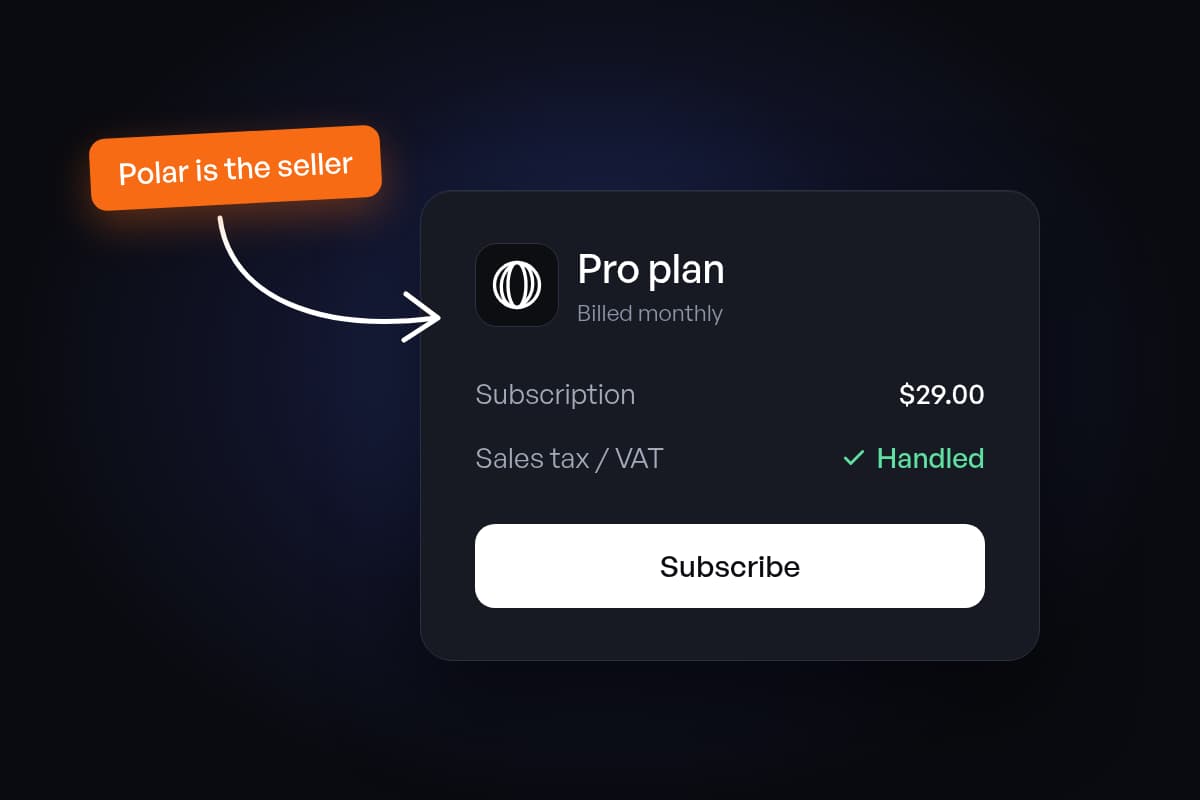
Stripe Managed Payments is Stripe's merchant of record for digital products. On a normal Stripe charge, your company is the seller. On a Managed Payments charge, Stripe (through Link) is the seller for that transaction: it calculates, collects, and remits indirect tax in the countries it lists, and it handles fraud screening, dispute responses, and transaction-level support. You still pay standard Stripe processing fees, plus 3.5% per successful Managed Payments transaction. Billing is a separate line.
Fees, country lists, and product rules below were read from Stripe's product page, pricing page, and Managed Payments docs on 26 November 2026, and from each other vendor's own pricing page the same day. The seller-versus-processor model is in the merchant of record guide. Head-to-head tables for the other MoRs live in Stripe alternatives and the four-way fee comparison.
Short answer
Use Stripe Managed Payments when your business is in one of the 37 locations on the eligibility page, you sell an eligible digital product (SaaS, software, digital content, self-serve courses), and you want Link to be the merchant of record on new Checkout or Payment Link sales without leaving your Stripe account. The published add-on is 3.5% per successful transaction, on top of Payments fees. There is no setup fee and no monthly minimum.
Skip it when you need Connect, a custom Elements or Payment Intents flow, physical goods, or a human-delivered service. Skip it when the lowest published MoR headline matters more than staying inside Stripe (Creem's pricing page is 3.9% + 40¢ with no international card line). Skip it when you can file indirect tax yourself: plain Stripe at 2.9% + 30¢ for US domestic cards, plus 0.7% Billing, plus 0.5% Stripe Tax Basic where you are registered, leaves you as the seller and is cheaper on the card math alone.
Definition: Stripe Managed Payments is a per-transaction merchant of record. Stripe, through Link, becomes the legal seller on Checkout Sessions and Payment Links where you set managed_payments[enabled] to true. Ordinary Stripe Payments charges are unchanged: you remain the merchant.
Is Stripe a merchant of record?
On Managed Payments transactions, yes. On everything else, no.
Stripe's Managed Payments docs put it in one row of a comparison table: the merchant of record is Stripe when Managed Payments is on, and your business when you use other Stripe products. The product FAQ is more specific about the brand the buyer sees: "Stripe (via Link) becomes the merchant of record." The how it works page says the customer sees Link as the merchant of record and sees purchases as Sold through Link. The card statement shows LINK.COM* plus your statement descriptor.
That is the whole "is Stripe a merchant of record" and "stripe mor" question. Stripe Payments is still a processor. Stripe Tax does not flip the seller. Managed Payments does, and only on the charges where you turn it on. You can keep direct processing in your home market and use Managed Payments for other markets or products. The product page calls that transaction-level control.
Two limits sit next to the yes:
- It is indirect tax. The pages describe sales tax, VAT, and GST: calculation, collection, filing, and remittance in supported countries. They do not say Managed Payments files your income or corporate tax.
- It is not every country, and not every product. Tax coverage and seller eligibility are different lists. Both are below.
What the 3.5% fee includes
The number is on two Stripe pages, both read on 26 November 2026.
The US pricing page lists Managed Payments at 3.5% per successful Managed Payments transaction in addition to Payments fees. The blurb on that same block says the fee includes indirect tax compliance (sales tax, VAT, GST) and remittance in more than 75 countries, along with fraud prevention, dispute management, invoicing, and customer support globally.
The product FAQ says the same 3.5% "includes global indirect tax (sales, VAT, GST), fraud prevention, dispute responses, and transaction-level support through Link." It also says optional products such as Billing and local payment methods are separate, and that there are no setup fees or monthly minimums.
Docs and the product page say indirect tax compliance in more than 80 countries. The pricing page says more than 75. The tax compliance doc is the list to use when a specific country matters. Counted from that page on 26 November 2026, it names 82 cross-border destinations. The round numbers do not match each other. Do not put "80" in a spreadsheet and assume every buyer country is covered.
What the 3.5% does not replace, from those same pages:
- Card processing. US pricing for domestic cards is 2.9% + 30¢ per successful transaction. International cards add 1.5%. If currency conversion is required, Stripe adds 1%. Those lines are on the pricing page, not inside the 3.5%.
- Stripe Billing. Pay-as-you-go Billing is 0.7% of Billing volume on the Billing pricing page. Managed Payments subscriptions use Billing. The 3.5% does not include it.
- Local payment method fees. The FAQ lists them as separate. This post does not restate those rates.
- A dispute received fee, and fees for dispute-prevention tools. The how-it-works page says received disputes incur a dispute received fee, and that Stripe may charge for dispute prevention tools it turns on. It does not print the dollar amounts, so they are not in the table below.
The pages also do not say whether the 3.5% is taken on the tax-inclusive total. Lemon Squeezy and Polar do say that about their own fees. Until Stripe prints the base, do not copy their rule onto Managed Payments.
What a $29 plan and a $100 plan cost
One charge, list price, tax left off so the rows match. US means a domestic US card on Stripe's published US card rate. Amounts are the vendor's printed percentages and fixed fees, combined first, then rounded to the cent (half up). Stripe Billing is included only on the rows that say Billing. Stripe Tax Basic is included only on its own row, at 0.5% per transaction on no-code integrations (Billing, Checkout, Invoicing, Payment Links) where you are registered.
| Setup (26 Nov 2026) | Fee on $29 | Fee on $100 |
|---|---|---|
| Stripe US card (2.9% + 30¢) | $1.14 | $3.20 |
| Stripe + Billing (plus 0.7%) | $1.34 | $3.90 |
| Stripe + Billing + Tax Basic (plus 0.5%) | $1.49 | $4.40 |
| Stripe + Billing + Managed Payments (plus 3.5%) | $2.36 | $7.40 |
| Paddle (5% + 50¢) | $1.95 | $5.50 |
| Polar Starter (5% + 50¢) | $1.95 | $5.50 |
| Creem (3.9% + 40¢) | $1.53 | $4.30 |
| Lemon Squeezy subscription (5% + 0.5% + 50¢) | $2.10 | $6.00 |
| Dodo Payments US subscription (4% + 0.5% + 40¢) | $1.71 | $4.90 |
The $29 Managed Payments cell is 29 × 0.071 + 0.30 (card rate, Billing, and the 3.5% added together). The $100 row uses the same formula. A non-US card adds the surcharges those vendors print: Stripe + Billing + Managed Payments becomes $2.79 / $8.90, Polar Starter $2.39 / $7.00, Lemon Squeezy's subscription line $2.53 / $7.50, and Dodo $2.14 / $6.40. Creem's page says there is no international card fee. Paddle does not print one. Stripe's +1% currency conversion, when required, is extra.
Plain Stripe plus Billing is the low row because you are still the seller. Creem is the lowest published MoR headline here. Managed Payments costs more because processing, Billing, and 3.5% all stay on the bill. You are paying for the seller job.
Polar's paid plans go as low as 3.4% + 30¢, plus a monthly fee. They are in the Polar payments review, not in this table, because a monthly fee makes one $29 charge the wrong comparison.
Which businesses, products, and buyers qualify
Managed Payments has a stricter gate than Stripe Payments. Stripe says access depends on an eligibility review of business type and geography. Direct integrations only. The eligibility page says it does not support Connect platforms, Express accounts, or accounts controlled by a platform.
Seller countries
Your business has to be based in a supported location. Counted from that page on 26 November 2026, the list is 37:
- North America (2): Canada, United States
- Europe (31): Austria, Belgium, Bulgaria, Croatia, Cyprus, Czechia, Denmark, Estonia, Finland, France, Germany, Greece, Hungary, Ireland, Italy, Latvia, Liechtenstein, Lithuania, Luxembourg, Malta, Netherlands, Norway, Poland, Portugal, Romania, Slovakia, Slovenia, Spain, Sweden, Switzerland, United Kingdom
- Asia Pacific (4): Australia, Hong Kong, Japan, Singapore
India is not on the seller list. A founder in India cannot turn Managed Payments on from an Indian Stripe account based on this page, even though India is on the customer tax list below. The same is true for most of the world outside those 37.
The changelog says Managed Payments became generally available on 22 April 2026 "to businesses in 39 countries, including new support for Australia." The live eligibility list today is 37 locations, not 39. This post uses the list, not the older sentence. Stripe does not explain the gap on the pages fetched today.
Products that qualify
Supported categories on the eligibility page: software, video games, digital media (audiobooks, e-books, magazines, newspapers, audio and video, images), online courses and training, and electronically supplied business and web services such as website hosting. The product page also names SaaS subscriptions, digital content, virtual goods, and app developers moving purchases from app stores to the web.
Each product needs an eligible tax code, set in the Dashboard or API. Eligible codes are labeled Eligible for Managed Payments. The practical SaaS codes on that table include:
txcd_10103000andtxcd_10103001: SaaS, personal use and business usetxcd_10103100andtxcd_10103101: SaaS with an electronic downloadtxcd_10105001throughtxcd_10105004: cloud AI tools (AIaaS), added in the changelog on 2 June 2026
The product page says tax responsibility covers 35 product categories. The eligibility page is a long tax-code table, not a list of 35 names. Use the tax code, not the slogan, when you create the product.
Explicitly unsupported: physical goods, professional services (consulting, marketing, design, development, tech support), and live in-person events. A further rule: the product has to be fully automated. Live 1-1 coaching does not qualify. You must sell direct, not through a marketplace, and you must hold the rights to distribute the product. If Stripe later decides a product is ineligible, it says you become responsible for the indirect tax and you must stop using Managed Payments for that product.
Buyer countries, and where tax is actually Stripe's job
Customers can buy from more than 195 countries and territories, except nine restricted places named on the eligibility page: Ascension Island, China, Cuba, Iran, Kosovo, North Korea, Russia, Syria, and Tristan da Cunha.
Tax coverage is narrower than "the buyer can pay." The tax compliance page says Stripe calculates, collects, registers, files, remits, and issues tax invoices for digital products in more than 80 countries, and that no action is required from you for indirect tax on those sales. Outside that set, you register, calculate, collect, file, and remit. You can still use Managed Payments as the merchant of record there for payments, fraud, disputes, and support. Invoices for those tax-unsupported sales use your business name and tax details. Covered sales are invoiced as Sold through Link.
The cross-border list, counted on 26 November 2026, is 82 destinations: the EU (27), the United States, Canada, the United Kingdom, Switzerland, Norway, and a long Asia Pacific set (including India, Japan, Singapore, Australia, South Korea), plus smaller lists in Africa and the Caribbean. A few rules inside "supported" still land on you:
- Japan: you handle tax on all domestic sales if your business is based in Japan.
- Singapore: you handle tax on domestic B2B sales (the buyer says they are purchasing as a business).
- Serbia: cross-border coverage applies only if you are not registered for VAT in Serbia.
In supported countries, some transactions come back with taxability_reason: not_subject_to_tax because of thresholds. Stripe still says it handles indirect tax compliance on those transactions.
Where Stripe will not cover tax, enable Stripe Tax (Settings, then Tax, then Integrations). It is the only tax product Managed Payments allows, and Stripe does not charge Tax calculation fees on those Managed Payments transactions. You still register and file outside the list. Tax Complete's price is not a simple public number, so it is not in the fee table.
Checkout, Payment Links, and Billing subscriptions
Managed Payments is not a second Stripe account. It is a flag on specific charges.
Surfaces that work, from the docs overview: Checkout and Payment Links. Subscriptions need Billing. Stripe Sigma can mark rows with managed_payments_enabled (added in the 22 April 2026 changelog).
Surfaces that do not work:
- Stripe Connect
- Elements with the Checkout Sessions API, and advanced Payment Intents integrations
- A subscription created outside Checkout or Payment Links
- Invoice items attached on a Customer object onto a Managed Payments subscription
- A one-off invoice on a Customer, or a subscription invoice outside the billing period
- Third-party tax tools
- A custom domain on the Managed Payments checkout page
The setup guide requires API version 2025-03-31.basil or later. You activate Managed Payments in the Dashboard, put an eligible tax code on each product, then create a Checkout Session with the flag:
const session = await stripe.checkout.sessions.create({
  mode: "subscription", // or "payment" for a one-time charge
  line_items: [{ price: priceId, quantity: 1 }],
  managed_payments: { enabled: true },
  success_url: successUrl,
});
Set managed_payments.enabled to false on a session that should stay a normal charge. The update guide says you can only enable Managed Payments for new subscriptions bought through a Managed Payments Checkout Session. Existing subscriptions are not eligible. Legacy subscribers stay on your current merchant setup until they buy again through a Managed Payments session.
Stripe removes some parameters because it now owns tax and parts of the customer record. automatic_tax has to come off: Managed Payments calculates and withholds tax itself. If you do not set tax_behavior on the price, tax is added on top of your price. Inclusive prices are a Dashboard tax setting, or tax_behavior: inclusive on the price.
Payment Links picked up Managed Payments at general availability (22 April 2026), in the Dashboard or the API. One-time payments and a mobile Checkout UI were already in the changelog on 22 September 2025. The public changelog's earliest entry on the page fetched today is 13 August 2025 (how withheld sales tax is treated on refunds). General availability is the date to cite. The product was in the docs before that date.
What the buyer actually sees
Adaptive Pricing is on by default. Stripe's product page says it localizes prices in 150+ countries, and that Checkout covers 30+ languages and 135+ currencies. Those figures are for Stripe's checkout surfaces.
Buyers can pay by card, Apple Pay, Google Pay, or Link, plus the local methods on the how-it-works table (Cash App Pay and UPI recur, Pix does not support daily subscriptions, Klarna and Afterpay are off until you ask Stripe, ACH Direct Debit is private preview). Guest checkout is allowed. Receipts and the subscription emails Link owns come from Link, and your Dashboard receipt settings do not change them.
Link is also the order portal: history, cancel, payment method, billing address. You can still offer the Customer Portal. You cannot set subscription.default_payment_method through the API on these subscriptions. Trials can start with no card (payment_method_collection: if_required). Turning renewal emails off does not turn off Stripe's anniversary emails (6 and 12 months in Australia and the UK, 12 months elsewhere, at least 7 days before).
Fraud, disputes, refunds, and support
Fraud. Stripe sets the rules and blocklists. Radar for Fraud Teams has been available since 15 August 2025 if you want extra rules, such as forcing 3D Secure. The product page's "38% average reduction in fraud" is a Stripe-wide figure printed on that page, not a Managed Payments-only study.
Disputes. Stripe can submit evidence without asking you, or accept a dispute that looks unwinnable. If you counter it yourself, an evidence submission fee applies. If Stripe submits the evidence, it covers that fee. The docs name a dispute received fee and say dispute-prevention tools can be billed. They do not print the dollar amounts.
Refunds. You can refund, and Stripe can refund within 60 days in some cases, including to avoid a chargeback. The customer gets the tax back. In some jurisdictions Stripe still remits the original tax and reduces your balance by that amount.
Support. Link handles payment and subscription questions. You keep product support. If Stripe asks you something and you do not answer within 48 hours, it may refund. The product page says this support is 24/7 and covers 16 languages.
Payouts. There is no separate reseller payout fee on the pages checked today: funds stay in your Stripe balance. The product page says payouts "can" be up to 4x faster than monthly MoR cycles, and it does not print a day count. Reports can split withheld_tax from fee_net_of_withheld_tax. A deletion request cancels that customer's Managed Payments subscriptions and deletes the related Stripe objects, then emails you.
Stripe Tax vs Managed Payments
This is the decision most "stripe tax vs managed payments" searches are actually asking.
| Stripe Tax | Stripe Managed Payments | |
|---|---|---|
| Who is the seller | You | Stripe, via Link, on those charges |
| What you pay | Tax Basic: 0.5% per transaction on Checkout, Billing, Invoicing, and Payment Links, where you are registered. Payment API calculations are 50¢ per transaction. | 3.5% per successful transaction, plus Payments fees. Billing still 0.7% if you use it. |
| Calculation | Yes, in 100+ countries on the Tax pricing page | Yes, in the Managed Payments tax list |
| Registration and filing | Tax Basic: no. Tax Complete: Stripe files directly for Canada federal simplified, EU non-Union OSS, and the US. Other countries go through partners. No simple public price for Complete. | Stripe registers, files, and remits in the countries on the tax compliance list. You still do that work outside the list. |
| Fraud, disputes, buyer support | Separate Stripe products (Radar, your own dispute responses) | Included in the 3.5%, with the limits above |
| Checkout control | Elements, Payment Intents, Connect, custom domains on Checkout where Stripe offers them | Checkout and Payment Links only. No Connect. No custom domain on the Managed Payments checkout. |
Stripe's FAQ draws the same line: with Tax you keep the liability, and with Managed Payments Link takes indirect tax on supported transactions. Use Tax Basic when you will own registrations and want the card rate. Use Managed Payments when you will not, and the account qualifies. The hybrid is real: Managed Payments where Stripe covers tax, Stripe Tax monitoring where it does not, with no extra Tax calculation fee on the Managed Payments charges.
Managed Payments vs Lemon Squeezy, Paddle, Polar, and Creem
Same job, different seller, different bill. Rates checked 26 November 2026 on each vendor's pricing or fee page.
| Seller | Headline | Stays inside your Stripe account | In TurboStarter | |
|---|---|---|---|---|
| Managed Payments | Link, per charge you flag | Processing + 3.5%. Billing extra. | Yes | Stripe provider, flag not built in |
| Lemon Squeezy | Lemon Squeezy, until 31 Mar 2027 | 5% + 50¢, plus 0.5% on subscriptions, plus 1.5% outside the US and 1.5% on PayPal | No | Yes, for stores that already exist |
| Paddle | Paddle | 5% + 50¢ per checkout. No monthly fee. | No | No |
| Polar Starter | Polar | 5% + 50¢, plus 1.5% on non-US cards | No. Payouts use Stripe Connect Express. | Yes |
| Creem | Creem | 3.9% + 40¢. Pricing page: no international card fee. | No | No |
| Dodo Payments | Dodo Payments | 4% + 40¢ US cards, plus 0.5% on subscriptions, plus 1.5% outside the US | No | Yes |
Lemon Squeezy (now Stripe-owned)
Lemon Squeezy joined Stripe on 26 July 2024. On 16 November 2026, cofounder JR Farr wrote that Lemon Squeezy is winding down. New store sign-ups are closed. Processing stops on 31 March 2027, and the post says that date will not be extended. Existing stores can charge until then.
The same post says Managed Payments is the product they set out to build, and that it is not a like-for-like replacement: digital fulfillment and storefronts need separate tools. Migration tooling "will be available on December 2" for businesses in a supported country. This page was checked on 26 November 2026, before that date, so this post does not claim the tool is live. Businesses outside the Managed Payments country list have to move to another provider. Lemon Squeezy offers a data export and a migration intake form for card subscriptions in that case.
On a $29 US subscription, Lemon Squeezy's published fee ($2.10) is lower than Stripe + Billing + Managed Payments ($2.36). That comparison has a deadline. The longer write-up is Lemon Squeezy vs Stripe.
Paddle, Polar, Creem, and Dodo Payments
Paddle is 5% + 50¢ per checkout, described as payments, billing, tax, fraud, chargebacks, and buyer support, with no monthly fee. Products under $10 have no public rate. At $29 that is $1.95, against $2.36 for the Managed Payments stack, and you leave Stripe's API. TurboStarter has no Paddle provider. See Paddle vs Stripe.
Polar Starter matches that 5% + 50¢ and adds 1.5% on non-US cards. Disputes are $15. Payouts go to Stripe Connect Express, so some countries that cannot be Managed Payments sellers can still get paid. The tradeoff is a separate platform versus a flag on the Stripe account you already have. See Polar vs Stripe and the Polar payments review.
Creem is 3.9% + 40¢, and the pricing page says there is no international card fee. Payouts run on the 1st and 15th. That is the lowest published MoR row here ($1.53 vs $2.36 at $29). Creem is not in the kit. See Creem vs Stripe.
Dodo Payments sits between them on a US subscription (4% + 40¢ plus 0.5%) and is a TurboStarter provider. The review is Dodo Payments. Managed Payments docs do not describe a usage-meter product. Stripe's own meters are covered in Stripe usage-based billing.
How to turn it on
Confirm the account, the product, and the API version
The business location has to be on the eligibility list, the account cannot be a Connect platform or Express account, and Stripe's review has to allow access. Activate Managed Payments in the Dashboard. Use API version 2025-03-31.basil or later. Put an eligible tax code on every product you will sell this way. SaaS that is only delivered in the browser wants a SaaS code, not a generic physical-goods code left over from an old product.
Flag new Checkout Sessions and Payment Links
Pass managed_payments: { enabled: true } on new subscription or one-time Checkout Sessions, or enable it on a Payment Link. Remove automatic_tax. Leave existing subscriptions on the old path. The update guide is explicit: you cannot flip a live subscription into Managed Payments.
Fulfill from checkout.session.completed (and the async payment events if you take delayed methods), not from the success-page redirect. That is the same rule as any other Stripe Checkout integration.
Point support at a real inbox, and read the fee column
Set the support email Stripe will use for escalations. If that inbox is quiet for 48 hours, Stripe may refund. In reports, split withheld tax from fees before you decide the 3.5% "looks higher than the pricing page." Tax Stripe remits is not your revenue and it is not the MoR fee.
Test with 4242 4242 4242 4242 and a few billing addresses. Link's test passcode in the docs is 000000. Sandbox does not email receipts until you send one from the Dashboard.
Where this fits TurboStarter billing
TurboStarter is a production-ready starter kit for web, mobile, extension, and AI from one backend. Billing providers are swappable. On the web, the billing overview ships Stripe (the default), Lemon Squeezy, Polar, and Dodo Payments behind one API. You change the provider export and map each plan to that vendor's price id.
Managed Payments is not a fifth provider, and the kit does not ship a toggle for it. The Stripe guide is hosted Checkout, Dashboard products and prices, and webhooks that include checkout.session.completed plus the subscription events in the webhooks doc. Turning it on means eligible tax codes, the managed_payments flag on the Checkout Session your server creates, and the parameter cleanup in Stripe's update guide.
Edge Kit is Stripe-only. Its billing overview already points at Managed Payments as a way to move tax work off a small team. The same eligibility rules apply there: Checkout, an eligible digital product, a business in one of the 37 locations.
If Lemon Squeezy is the store you sell through today, treat 31 March 2027 as a real stop, and read Lemon Squeezy vs Stripe before you assume Managed Payments can host license keys and a storefront. If you would rather keep a separate merchant of record that the kit already wires up, Polar and Dodo Payments are the providers in the overview. The ownership that matters is the billing boundary in your repo, so the next seller is a configuration change.
When to use it, and when to stay on plain Stripe
- Plain Stripe, plus Tax if you are registered. Most buyers are in one or two countries, you can file, or you sell B2B on reverse charge and your accountant is comfortable. You need Connect, Elements, or a custom domain on Checkout. You want the $1.34 stack on a $29 renewal instead of $2.36.
- Stripe Managed Payments. You are already on Stripe Checkout, the business is in the 37 locations, the product is automated digital, and global VAT would own the calendar. You are fine with Link on the receipt, no Connect, and new subscriptions only. A hybrid (home market direct, other markets Managed Payments) is what Stripe's product page describes.
- Another merchant of record. You want a lower published all-in rate than processing plus 3.5% plus Billing (Creem, Polar, Dodo, Paddle on the numbers above). Your country is not on the seller list. You need license keys, a storefront, or affiliates. Lemon Squeezy is a migration source now.
FAQ
Stripe's merchant of record for digital products. On Checkout and Payment Links where you enable it, Link is the seller. Stripe handles sales tax, VAT, and GST in the countries on its tax compliance list, plus fraud responses, dispute handling, and transaction-level support. You pay standard processing fees plus 3.5% per successful transaction. Checked 26 November 2026 on stripe.com/managed-payments and the Managed Payments docs.
Only when Managed Payments is on for that charge. Stripe's docs say the merchant of record is Stripe for Managed Payments and your business for other Stripe products. The buyer sees Sold through Link, and the statement descriptor starts with LINK.COM. Stripe Tax does not make Stripe the seller. You still owe income tax where you live: the Managed Payments pages describe indirect tax, not income tax.
3.5% per successful transaction, on top of Payments fees, with no setup fee and no monthly minimum. On a US card, a $29 subscription with Billing is about $2.36 (2.9% + 30¢, plus 0.7% Billing, plus 3.5%). A $100 charge on the same stack is $7.40. International cards add 1.5% on Stripe's US pricing page. Billing and local payment methods are extra. The dispute received fee has no dollar amount on the docs page checked today.
The eligibility page lists 37 business locations, counted 26 November 2026: the United States, Canada, 31 European countries (including the UK, Switzerland, and Norway), plus Australia, Hong Kong, Japan, and Singapore. Buyers can pay from more than 195 countries except nine restricted territories, including China, Cuba, Iran, North Korea, and Russia. Tax filing is a shorter list (82 cross-border destinations on the tax compliance page). Japan domestic sales and Singapore domestic B2B sales stay your tax job even though those countries are seller locations.
The changelog marks general availability on 22 April 2026, for businesses in 39 countries, including Australia. The same page shows earlier product changes, including one-time payments on 22 September 2025 and a refund tax note on 13 August 2025. The live seller list on 26 November 2026 has 37 locations. Payment Links support shipped with general availability.
Tax Basic (0.5% where you are registered, on Checkout and Billing) calculates and collects. You remain the seller, and you file, unless you buy Tax Complete. Managed Payments makes Link the seller and files indirect tax in its country list, at 3.5% plus processing. Use Tax when you will own compliance and want the lower card stack. Use Managed Payments when you will not, and your account qualifies.
On a $29 US subscription, published fees are about $2.36 for Stripe plus Billing plus Managed Payments, $2.10 for Lemon Squeezy, $1.95 for Paddle or Polar Starter, $1.71 for Dodo Payments, and $1.53 for Creem. Lemon Squeezy stops processing on 31 March 2027. Paddle, Polar, Creem, and Dodo are separate merchants of record. Managed Payments is the option that stays on your existing Stripe Checkout integration.
New subscriptions created through a Managed Payments Checkout Session or Payment Link, yes. Existing subscriptions, no. Stripe's update guide says they are not eligible. Keep fulfilling them as you do now. Subscriptions also cannot be created outside Checkout or Payment Links, and Connect is unsupported. Billing's 0.7% still applies.
Stripe Managed Payments makes Link the seller at 3.5% on top of processing, for new Checkout and Payment Link sales of eligible digital products from 37 business locations. Plain Stripe plus Stripe Tax stays cheaper when you will file. Creem, Polar, Paddle, and Dodo Payments publish lower MoR headlines when leaving Stripe is acceptable. Rates on this page were taken from the vendor pages on 26 November 2026.
Stripe Alternatives for SaaS in 2026: How to Choose
Stripe alternatives for SaaS in 2026: merchant of record vs processor, fees checked 23 Nov, and when staying on Stripe is the right call.
Stripe Usage-Based Billing: Meters, Credits and Code (2026)
Implement Stripe usage-based billing with Billing Meters, meter events, credit grants, and TypeScript for tokens, hybrid overage, and prepaid credits.