Best SaaS stack for shipping in 2026: the complete guide
The production SaaS stack for 2026: Next.js, Hono, Better Auth, Drizzle, PostgreSQL, and billing. What to ship, which layers matter, and how TurboStarter wires it all in one monorepo.
If you are searching for the best SaaS stack in 2026, you probably do not want a vague list of trendy logos. You want a stack that gets you to production billing, teams, and retention without a rewrite in six months.
Short answer
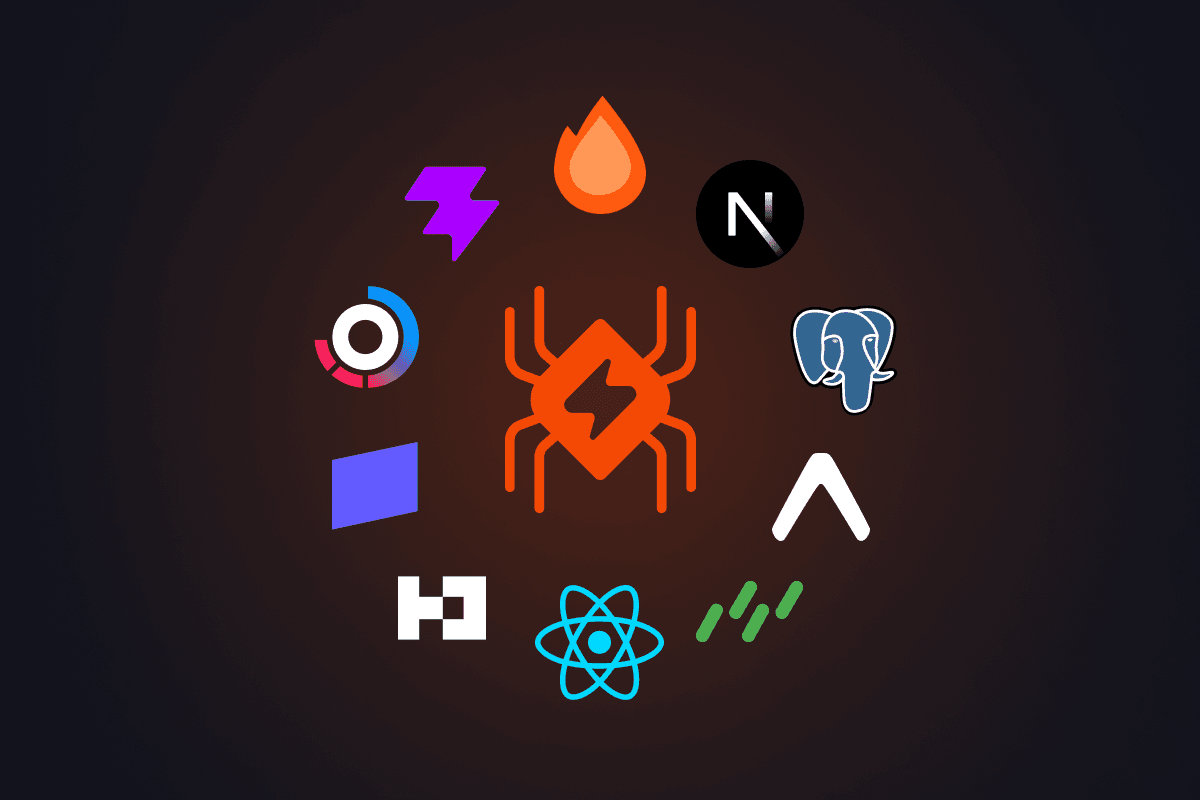
The best default SaaS stack is Next.js + TypeScript + PostgreSQL + Drizzle + Better Auth + Hono + React Query + Tailwind CSS + shadcn/ui, in a Turborepo monorepo that can also ship Expo mobile and WXT browser extension clients from the same packages. Add Stripe, Lemon Squeezy, Polar, or Dodo Payments for billing, Resend (or Mailgun/SendGrid/Nodemailer) for email, and PostHog or Sentry for analytics and monitoring. TurboStarter ships this entire foundation (auth, billing, orgs, admin, feature flags, marketing, API, storage, and docs) so you skip months of infrastructure and build what makes your product unique.
What is a SaaS stack in 2026?
A SaaS stack is the set of frameworks, databases, auth, billing, email, analytics, and deployment tools you use to build and operate a subscription software product. In 2026, the winning stacks share three traits: end-to-end TypeScript, PostgreSQL as the system of record, and modular auth/billing you can extend without vendor lock-in.
The goal is not to pick the most hyped tools. It is to minimize time to first paid user while keeping a codebase you can maintain after launch.
The core tech stack (what TurboStarter actually runs)
This is the stack documented in TurboStarter web docs, chosen for shipping speed, type safety, and the ability to share code across web, mobile, and extension apps.
| Layer | Pick | Role in production SaaS |
|---|---|---|
| Monorepo | Turborepo | One repo for web, mobile, extension, and shared packages |
| Web app | Next.js (App Router) + React | Marketing site, authenticated product, serverless API host |
| Mobile app | Expo + React Native | iOS/Android from the same business logic |
| Browser extension | WXT + Vite | Chrome, Firefox, Edge (Manifest V3 ready) |
| API | Hono | Ultrafast serverless endpoints, typed RPC client, middleware for auth and RBAC |
| Data fetching | React Query | Caching, mutations, and sync between clients and API |
| Database | PostgreSQL | Subscriptions, orgs, permissions, audit trails |
| ORM | Drizzle (vs Prisma) | Type-safe SQL, migrations, connection pooling |
| Auth | Better Auth | Sessions, OAuth, MFA, passkeys, org plugins. You own the data |
| UI (web/extension) | Tailwind CSS + Base UI + shadcn/ui | Accessible components you fully own |
| UI (mobile) | Uniwind + react-native-reusables | Tailwind-style styling on native |
| Billing | Stripe · Lemon Squeezy · Polar · Dodo Payments | Subscriptions, one-time, metered, per-seat, credits, webhooks |
| Resend · Mailgun · SendGrid · Postmark · Nodemailer + React Email | Transactional and marketing templates | |
| Storage | S3-compatible (R2, AWS, MinIO) | Presigned uploads, file management |
| CMS | Content Collections + MDX | Blog, docs, legal pages in git |
| Analytics | PostHog · GA · Plausible · Umami · others | Product and marketing analytics |
| Feature flags | OpenFeature · PostHog · GrowthBook | Remote config, rollouts, and experiments |
| Monitoring | Sentry · PostHog | Errors, performance, source maps |
| Background jobs | Upstash QStash | Serverless queues and cron without managing workers |
| Mobile deploy | EAS | Builds, store submission, OTA updates |
Principles from the TurboStarter docs: as simple as possible, as few dependencies as possible, as performant as possible. You can use the full stack or treat it like LEGO and remove what you do not need.
What a production SaaS must ship (beyond the framework)
Generic "pick Next.js and Stripe" guides stop at logos. A stack only matters once it covers the product surface customers and operators touch. Here is what TurboStarter core includes out of the box, and what you would otherwise build by hand.
Authentication
Email, OAuth, MFA, passkeys, magic links, and ready-made auth views.
Organizations
Multi-tenant orgs, invites, roles, and seat management for B2B.
Billing
Stripe, Lemon Squeezy, Polar, Dodo — subscriptions, metered usage, and checkout UI.
API layer
Hono routes, protected middleware, plan-based access, typed clients.
Admin
Super-admin UI, user search, MFA management, impersonation.
Marketing
Landing page, waitlist, newsletter, blog, SEO, i18n, contact forms, and legal pages.
Feature flags
OpenFeature flags with in-memory, PostHog, or GrowthBook on web, mobile, and extension.
Authentication
- Email/password with validation and security defaults
- Magic links (passwordless) with rate limiting
- Password recovery flow
- MFA / 2FA (TOTP, authenticator apps)
- Passkeys (FIDO2/WebAuthn)
- OAuth (Google, GitHub, extensible to more providers)
- Anonymous sessions where needed
- Ready-to-use auth views and components
Docs: auth overview
Organizations and teams (B2B)
- Multi-tenant organization model
- Teams, members, and seat management
- Email invitations with roles and expiry
- Role-based permissions scoped per organization
Docs: organizations overview
Billing
- Recurring subscriptions and one-time payments
- Metered usage, per-seat, credits, and plan limits
- Organization (B2B) billing alongside personal accounts
- Custom plans and pricing tiers
- Webhook handling and provider sync
- Ready-made pricing, checkout, and billing UI
- Multiple providers: Stripe, Lemon Squeezy, Polar, Dodo Payments
Docs: billing overview · payment provider comparison
API layer (Hono, not a second backend framework)
TurboStarter centralizes business logic in a Hono API hosted with Next.js:
- Serverless architecture with auto-scaling endpoints
- Protected routes via middleware: session checks before handlers run
- Feature-based access tied to subscription plans
- Typesafe client (
hc<AppRouter>) so web, mobile, and extension share one contract - Zod validation at the edge of every mutation
Auth routes live in the same API layer, so sessions stay consistent across apps.
Docs: API overview · protected routes · build a feature recipe
Admin and operations
- Super admin UI with overview metrics
- User search, status, auth methods, MFA management
- Granular admin roles and permissions
- User impersonation for support and debugging
Docs: admin overview
Database
- Type-safe queries, joins, filters, pagination
- Schema migrations with version control
- Connection pooling (standalone or serverless)
- Shared validation types from DB to API to UI
Docs: database overview
Marketing and growth
- Landing page: hero, features, pricing table, testimonials, FAQ with schema
- SEO: meta tags, Open Graph, automatic sitemaps
- Blog: categories, RSS, MDX content collections
- Legal pages with version control
- Contact form with spam protection
- Internationalization: locale routing, language switcher, translated emails
Docs: marketing pages · CMS overview
Storage, email, observability, and flags
- S3-compatible uploads with progress and validation
- Transactional and marketing email templates (dark mode supported)
- Analytics event tracking, page views, cross-device identification
- Error monitoring with source maps (Sentry, PostHog, and more)
- Feature flags via OpenFeature (in-memory, PostHog, or GrowthBook)
Docs: storage · emails · analytics · monitoring · feature flags
AI-ready (optional layer)
- Multiple LLM providers (OpenAI, Anthropic, Groq, Mistral, Gemini)
- Streaming chat components
- Custom rules and prompts for AI editors
For full AI apps (agents, image gen, TTS), see AI Kit.
Testing and deployment
- Unit, integration, and E2E tests (including Playwright on web)
- CI/CD workflows and one-click deploy patterns
- Docker self-hosting with a built-in generator
- EAS for mobile builds and over-the-air updates
Docs: Docker deployment · self-host in 5 minutes
Multi-platform: one monorepo, three clients
The biggest stack decision in 2026 is not "which CSS framework." It is whether your product spans more than a website.
Web, mobile, and extension apps call the same Hono API with the same typed client. Auth sessions, billing entitlements, and org membership stay consistent whether your user is in the dashboard, on their phone, or in a browser popup.
That is the stack TurboStarter documents in web, mobile, and extension guides, with live demos on web, App Store, and Chrome Web Store.
Stack choices by product type
B2B SaaS with teams
Prioritize orgs, RBAC, admin, and seat billing.
B2C subscription
Prioritize fast checkout, simple auth, and mobile UI.
AI SaaS
Prioritize streaming UI, usage limits, and background jobs.
Browser-extension SaaS
Prioritize MV3, extension auth sync, and shared API.
Global product
Prioritize i18n, translated emails, and locale routing.
| Product type | What to prioritize | TurboStarter path |
|---|---|---|
| B2B SaaS with teams | Orgs, RBAC, admin, seat billing | Organizations + admin |
| B2C subscription | Fast checkout, simple auth, mobile UI | Web + Expo app |
| AI SaaS | Streaming UI, usage limits, background jobs | AI docs + QStash tasks |
| Browser-extension SaaS | MV3, extension auth sync | Extension stack |
| Global product | i18n, translated emails, locale routing | Internationalization |
Build from scratch vs starting from TurboStarter
A boilerplate is not cheating. It is buying back time on solved infrastructure so your first sprint targets differentiation, not another Stripe webhook handler.
Boilerplate vs scratch vs free starter
| Approach | Time to billable MVP | Main risk |
|---|---|---|
| DIY from tutorials | 8–14 weeks | Webhook bugs, auth edge cases, no admin |
| Free Next.js SaaS Starter | 2–4 weeks wiring gaps | Web-only, minimal B2B and ops |
| TurboStarter | Days to 2 weeks | Upfront cost; you still build unique features |
For the full build-vs-buy breakdown, read SaaS boilerplate vs building from scratch. For a kit-by-kit shootout, read best SaaS starter kit 2026.
TurboStarter includes what thin competitor guides hand-wave: the full auth matrix, multi-provider billing, orgs, Hono API with plan-based access, super-admin UI, landing page, blog, docs, emails, storage, i18n, feature flags, monitoring hooks, Docker local dev, and AI coding rules (AI development guide). That is the gap between "I have a login page" and "I can sell a team plan tomorrow."
AI-assisted development is part of the stack
In 2026, how you build matters as much as what you deploy. Cursor, Claude Code, and ChatGPT Codex only help when the repo has clear boundaries:
- Strict TypeScript and Zod at API edges
- Obvious package ownership (
auth,billing,db,api) AGENTS.mdand skills documenting conventions- Repeatable commands (
pnpm dev,pnpm services:setup)
TurboStarter ships AI development docs for web, mobile, and extension, so agents know where auth, billing, and features live instead of inventing parallel patterns.
Read: Cursor AI best practices · vibe-coding starter kit
Pre-launch checklist
Before your first paying customer:
Common mistakes
MongoDB for billing and teams. Use Postgres unless you have a specific reason not to.
A separate backend on day one. Hono inside Next.js covers most SaaS until you need polyglot services or heavy workers.
Auth0 before you need it. Self-hosted Better Auth keeps B2B org data in your database.
Web-only when mobile is on the roadmap. Share packages now; migrate later costs more than an empty Expo app folder.
Stack debates over distribution. Pick for your 12-month product surface, not Twitter polls.
Frequently asked questions
The best default stack is Next.js, TypeScript, PostgreSQL, Drizzle, Better Auth, Hono, React Query, Tailwind CSS, and Stripe or Lemon Squeezy, in a Turborepo monorepo when you need web plus mobile or browser extension clients. TurboStarter implements this stack with production auth, billing, orgs, admin, feature flags, marketing, and API layers documented in core docs.
DIY from tutorials: 2–4 months for auth, billing, teams, admin, and marketing. With TurboStarter: 1–2 weeks to a billable MVP, then focus on unique product value.
For most SaaS through Series A, Hono hosted with Next.js is enough: typed routes, middleware, serverless scaling, shared types to mobile and extension. Split out only when you need independent scaling or non-Node services.
TurboStarter uses Drizzle for SQL transparency, light runtime, and tight TypeScript inference. Prisma is fine if your team already standardizes on it; both work with PostgreSQL. Full breakdown: Drizzle vs Prisma in 2026.
Knowing logos and shipping production auth, billing webhooks, org RBAC, admin UI, emails, storage, SEO, and tests are different jobs. TurboStarter wires the documented feature set; the Next.js SaaS Starter is the free minimal alternative if you enjoy wiring the rest.
Turborepo monorepo with Next.js, Expo, WXT, Hono, React Query, Better Auth, PostgreSQL, Drizzle, Tailwind CSS, Base UI, shadcn/ui, billing via Stripe / Lemon Squeezy / Polar / Dodo Payments, email via Resend / Mailgun / SendGrid / Nodemailer, S3 storage, Content Collections CMS, and integrations for PostHog, Sentry, and QStash background tasks. See web tech stack for the full breakdown.
Ship the product, not the plumbing
The best SaaS stack in 2026 is the one that gets you to paid users with maintainable code (web, mobile, and extension if you need them) without reimplementing auth and billing for the hundredth time.
If you want this stack already built, tested, and documented, start with TurboStarter. Run pnpm services:setup and pnpm dev, read the docs, and spend your first real sprint on the problem only you can solve.
Best practices for Cursor AI to build your startup 10x faster
Learn how to use Cursor effectively across a TurboStarter monorepo with Next.js web, React Native mobile, and Vite browser extension apps to ship faster.
Best SaaS starter kit 2026: 9 boilerplates compared
Compare the best SaaS starter kits in 2026 by stack, pricing, auth, billing, teams, AI readiness, and long-term maintainability.