Which TurboStarter kit to choose: Core, AI, Edge, or OpenClaw
Which TurboStarter kit to choose? Compare Core, AI, Edge, and OpenClaw by platform, runtime, and AI depth, and see when the All-in-One bundle pays off.
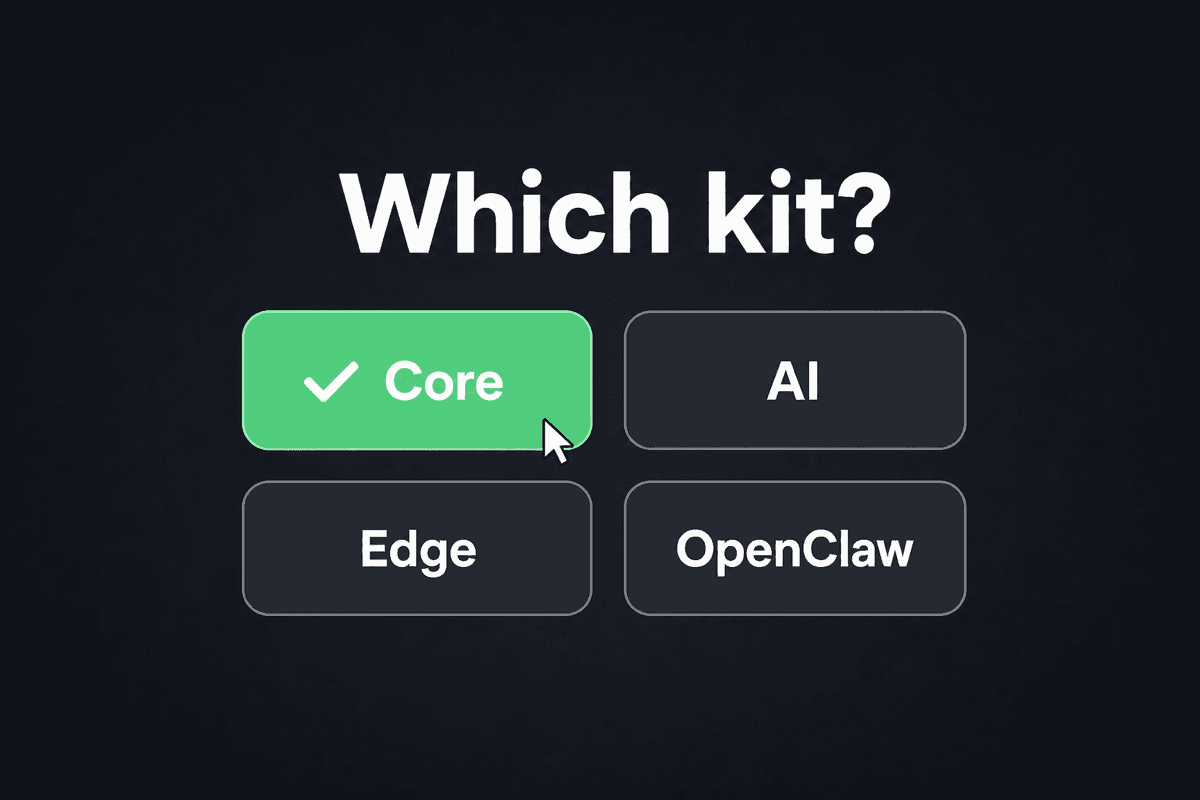
Every product page makes its kit sound like the obvious pick. That is exactly why so many people message us before buying. Which TurboStarter kit to choose comes down to three things you already know about your product: where it has to run, what you are selling, and whether AI is a feature or the whole point.
This guide gets you to an answer in a few minutes, with the same tradeoffs we would walk you through on Discord.
Short answer
Choose Core Kit for a full SaaS foundation on Next.js and PostgreSQL, especially if you need teams, an admin panel, payment provider choice, a mobile app, or a browser extension. Choose Edge Kit for a web-only SaaS built natively for Cloudflare Workers with TanStack Start and D1. Add AI Kit when complete AI features like persisted chat, RAG, image generation, or voice are the product; most paid AI products pair it with Core for accounts and billing. Choose OpenClaw Kit only if you sell hosted OpenClaw instances. The All-in-One bundle (Core, AI, and Edge) pays off when you will use at least two of those three.
What a TurboStarter kit is (and is not)
A TurboStarter kit is a standalone starter repository: full source code, its own stack, its own documentation, and lifetime updates. You clone it, rebrand it, and build your product on top of it.
What a kit is not is a plugin. Kits do not snap together into one app. Core and Edge use different frameworks and runtimes, and Core and AI share package names that have different responsibilities. Whatever you buy, one kit becomes the owner of your application. Other kits contribute features or serve as reference code.
Keep that rule in mind and most of the confusion disappears.
The four kits side by side
| Kit | Built on | Platforms | Best for |
|---|---|---|---|
| Core Kit | Next.js, Hono, PostgreSQL, Drizzle, Better Auth | Web, iOS and Android (Expo), browser extension | B2B and B2C SaaS, multi-platform products |
| AI Kit | Next.js, Expo, Hono, AI SDK, PostgreSQL with pgvector | Web, iOS and Android | AI-first products and complete AI features |
| Edge Kit | TanStack Start, Vite, Cloudflare Workers, D1, Drizzle | Web | Web SaaS that runs natively on Cloudflare |
| OpenClaw Kit | Next.js, Hono, Docker, PostgreSQL, Stripe | Web | Selling hosted OpenClaw assistant instances |
Each kit has a live demo, so you can click through the actual product before deciding: Core, AI, Edge, and OpenClaw.
How to choose a TurboStarter kit in three questions
Answer these in order. The first "yes" usually decides it.
1. Are you selling hosted OpenClaw instances?
OpenClaw is an open-source, self-hosted AI assistant that connects chat apps like WhatsApp, Telegram, and Slack to AI agents. A "wrapper" business sells customers their own managed instance.
If that is your business, choose OpenClaw Kit and stop here. It is built around per-customer provisioning: it spins up a dedicated OpenClaw instance on a VPS, Google Cloud, or Fly.io, puts it behind automatic HTTPS, and bills the customer with Stripe subscriptions. None of the general SaaS kits do provisioning.
If you are building anything else, including products that use AI agents, OpenClaw Kit is not the right base.
2. Do you need mobile, an extension, teams, or PostgreSQL?
If any of these is true, today or on your 12-month roadmap, choose Core Kit:
- A native iOS or Android app, with in-app purchases through RevenueCat or Superwall
- A browser extension for Chrome, Firefox, or Microsoft Edge
- Organizations, invitations, roles, or per-seat billing
- A super admin panel with user impersonation for support
- PostgreSQL as your system of record
- A payment provider other than Stripe (Lemon Squeezy, Polar, or Dodo Payments)
- Hosting on Vercel, Docker, a VPS, or anywhere a Node.js app runs
Core is the broadest kit. Its web app, mobile app, and extension share one API and one auth system, which is the hard part of a cross-platform SaaS.
If none of these apply and you want your product on Cloudflare, choose Edge Kit.
3. Is AI a feature or the product?
If AI is a feature, such as an assistant panel, a "summarize" button, or a streaming chat inside your dashboard, your base kit already covers it. Core includes an authenticated streaming chat endpoint on the AI SDK with multiple providers. Edge includes an AI foundation on TanStack AI with Workers AI and AI Gateway.
If AI is the product, such as a ChatGPT-style app with model switching and web search, chat over your own documents, an image playground, or real-time voice, add AI Kit. Its chat, RAG, image, voice, and text to speech templates are complete product slices, not snippets.
AI Kit is the AI layer, not a full SaaS
AI Kit starts with anonymous sessions and a demo credit balance. Full account flows, subscriptions, organizations, and admin come from Core. That is why most people selling an AI product start from Core and port AI Kit templates into it, as described in the AI Kit integration recipe.
Core vs Edge: the decision most buyers are stuck on
Core and Edge are both complete web SaaS foundations, which is why this is where most "I'm considering multiple kits" conversations end up.
The question is not "Cloudflare or not." Core can run on Cloudflare Workers with OpenNext, with Hyperdrive connecting to your Postgres. The real question is whether you want a Node-shaped app that can deploy to Cloudflare, or an app designed for Workers from the first line.
| Core Kit | Edge Kit | |
|---|---|---|
| Framework | Next.js App Router | TanStack Start on Vite |
| Runtime | Node.js on any host, Cloudflare via OpenNext | Cloudflare Workers, deployed as one Worker |
| Database | PostgreSQL by default, with MySQL and SQLite guides | Cloudflare D1, with existing Postgres reachable through Hyperdrive |
| Server layer | Hono API shared by web, mobile, and extension | TanStack Start server functions and HTTP handlers |
| Authentication | Password, magic links, OTP, passkeys, 2FA, OAuth, anonymous | Password, Google, GitHub, and Cloudflare OAuth, anonymous |
| Teams | Organizations, invitations, roles, organization billing | Individual accounts |
| Billing | Stripe, Lemon Squeezy, Polar, Dodo Payments; subscriptions, one-time, metered, per-seat, credits | Stripe subscriptions, trials, promotion codes, customer portal |
| Admin | Super admin with impersonation | Not included |
| Infrastructure | You pick providers for email, storage, jobs, analytics, and monitoring | Cloudflare bindings for R2, KV, Queues, Email, Turnstile, Workers AI, Flagship |
| Platforms | Web, mobile, extension | Web |
Choose Edge when you want the whole product on one Cloudflare account and one deploy, global by default, with individual customer subscriptions. It is the more focused kit: fewer providers to sign up for, fewer moving parts, and a typed, explicit data flow that is easy for you and your coding agent to follow.
Choose Core when the product is B2B or might become B2B, when mobile or an extension is on the roadmap, or when you want to choose your own providers.
A useful rule: if you can say "web only, individual accounts, Stripe, Cloudflare" about your product for the next year, Edge is a great fit. If you hesitate on any of those words, choose Core. Moving a whole app between the two later is a framework migration, not a config change.
Which TurboStarter kit fits common products
| You are building | Choose | Why |
|---|---|---|
| B2B SaaS with teams, roles, and seat-based pricing | Core | Organizations, RBAC, per-seat billing |
| Mobile app with a web dashboard | Core | Expo app on the same API, native in-app purchases |
| Browser extension with paid plans | Core | Extension client against the shared backend |
| Web-only micro SaaS on Cloudflare | Edge | One Worker with D1, R2, Queues, and Stripe |
| AI writing or tutoring tool on Cloudflare | Edge | Streaming AI on Workers AI is already wired |
| ChatGPT-style app, document chat, image, or voice product, with subscriptions | Core + AI | AI Kit templates inside Core's accounts and billing |
| AI prototype or internal tool with no billing yet | AI | Templates work with anonymous sessions |
| Hosted OpenClaw assistant business | OpenClaw | Per-customer provisioning and billing |
| Agency shipping different client projects | All-in-One | Pick the right base for each client |
If you are building a multi-tenant product, our guide to building multi-tenant SaaS explains why organizations are worth having from day one.
Combining kits without making a mess
Combining kits is common. Merging them is not. Here is how each pairing works in practice:
- Core + AI is the supported combination, with a recipe for each direction. Start from Core and port AI templates in, or keep an existing AI Kit app and bring Core features into it. Port one feature at a time, starting with chat, and keep a single owner for each shared package.
- Edge + AI use different frameworks, so you do not copy AI Kit code into Edge. AI Kit's templates become a reference for features you build on Edge's TanStack AI foundation.
- Core + Edge are separate products. A typical setup is Core for your main B2B app and Edge for a lightweight Cloudflare-native side product. Never merge the two repositories.
What it costs, and when the bundle pays off
Every kit is a one-time purchase with lifetime access to its repository and free updates. List prices at the time of writing (October 2026):
| Option | Price |
|---|---|
| Core Kit | $249 |
| AI Kit | $249 |
| Edge Kit | $249 |
| OpenClaw Kit | $149 |
| All-in-One (Core + AI + Edge) | $599 |
Check current pricing for launch offers and regional discounts.
The bundle math is simple:
- One kit: buy just that kit.
- Two of Core, AI, and Edge: two kits cost $498 at list price, so the bundle adds the third for about $100 more.
- All three: the bundle saves $148 over buying separately.
You do not have to decide everything today. Existing customers can claim a one-time 10% code from their dashboard for their next kit, so starting with one kit and adding a second later costs little extra.
What the bundle covers
All-in-One includes Core, AI, and Edge. OpenClaw Kit is sold separately, and the bundle covers the kits included in it when you buy, not kits launched later.
Mistakes we see before people buy
- Buying Edge for a mobile app. Edge is a Cloudflare web app. Mobile and extension starters ship with Core.
- Expecting AI Kit to be a complete SaaS. It is the AI layer. If you plan to charge users, plan on Core for accounts, billing, and admin.
- Merging two kit repositories. Shared package names collide, and you end up with two auth systems. Pick one owner and port features into it.
- Choosing Edge when you need teams or Postgres. Organizations do not ship with Edge, and D1 is its application database. If either is a requirement, Core is the shorter path.
- Buying the bundle "just in case." It is great value when you will use two or more kits. If you only need one, buy one and claim the returning-customer discount if your plans change.
Frequently asked questions
No. Edge is a separate codebase built on TanStack Start, Vite, D1, and Wrangler from day one. Core is a Next.js and PostgreSQL stack that can deploy to Cloudflare through OpenNext and Hyperdrive. Choose Edge for a Cloudflare-native web product, and Core when you need its broader feature set or other platforms.
Not always. Core and Edge both include streaming AI foundations that are enough for AI features inside a product. Add AI Kit when you want complete templates such as persisted chat with model switching, RAG over documents, image generation, voice, or text to speech.
Yes. Every kit license lets you build unlimited end products, including client projects, as long as clients do not receive the kit's source without their own license. Teams need one license per developer. The license has the full terms.
Your product logic, schema design, and UI ideas carry over. The framework, runtime, auth, and billing wiring do not, so switching between Core and Edge is a migration. Adding AI Kit features to Core later is a documented, incremental process.
No. All-in-One includes Core, AI, and Edge. OpenClaw Kit is a separate purchase, and kits launched after your purchase are not added automatically.
Core Kit. It covers the widest range of products, deploys almost anywhere (including Cloudflare), and gives you room to add mobile, an extension, or AI templates later. If you are still deciding, email hello@turbostarter.dev with what you are building before you buy.
Yes. Each kit has a live demo and public documentation. Start with the Core docs, AI docs, or Edge docs, and use the kit selection recipe as a checklist while you compare.
The verdict
Choosing a TurboStarter kit is not about finding the "best" one. It is about matching the kit to where your product runs and what it sells:
- Core for a full SaaS foundation across web, mobile, and extensions
- Edge for a focused, Cloudflare-native web SaaS
- AI Kit on top of Core when AI is the product
- OpenClaw Kit for an OpenClaw hosting business
Pick the kit that owns your app, ship the first version, and add another kit only when your roadmap asks for it. If you want the full comparison against other starters too, see how TurboStarter stacks up on our comparison pages.